Commander,
I appreciate your comments. They are certainly worth commenting on and looking into. My brother and I have spent literally hundreds of hours studying engine blocks, theory, etc. We have all sorts of books on engines and how to make them. Incidentally, our favorite bathroom reading material is "Allied Aircraft Piston Engines of World War II" by Graham White, and Sir Harry Ricardo's "The High Speed Internal Combustion Engine." I highly recommend anyone who is interested in engines read both of them--many times. We have spent hours upon hours in museums studying engines, talking to engine builders in all forms of racing, and fortunately, using engines in all sorts of conditions.
My point on the ribs is I think they do nothing to add to the stiffness of the block in the actual application we are interested in. As for 7000 horsepower drag race engines, I readily admit I have no knowledge or interest in them as I seriously doubt anyone will push our engines to much more than 700hp. After spending the day on the track at Miller Motorsports and hearing EVERYONE (including myself) lift before the end of the straight I can assure you no one is using all the horsepower they currently have--and many of our customers only have 500 horsepower engines.
Why do I think the ribs add "nothing"...
Well, I base that on the observations of many, many motors. As I mentioned, the latest Ford 5.4 doesn't have ribs and is capable of 1000 horsepower (more than I need). Perhaps Ford put ribs in later blocks (I don't know, but you mentioned they did) because people were intending to blow them to ridiculous horsepower figures I simply don't intend to achieve. 700 horsepower is enough; 800 horsepower would thrill me as it is a wide margin of safety. (I am not sure why you mentioned I was only interested in 600 horsepower.) I am sorry if you understood me that way--I should have explained things better.
But, the list of engines without ribs is much longer. The Rolls Royce Merlin, and all radial engines of WWII didn't have ribs. Before anyone says that radial engines are a different monster because all pistons push on the same crank journal, remember there are several radial engines that had multiple cylinders in line (albeit twisted to put the other jugs into the air stream.) Finally, one of the greatest race engines of all time, the Porsche 917, produced 1200 horsepower--and it had no ribs...it is a flat (opposed) engine.
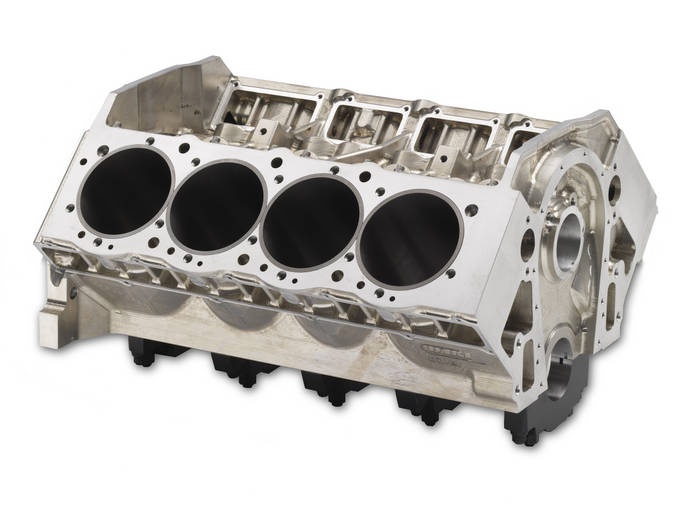
After taking all of those things into consideration, I decided the ribs were insignificant in the overall strength of what I wanted to achieve. the length of the water jacket had nothing to do with the decision. I could have made individual plates between the ribs had I been so inclined. See the picture of the latest DART billet block with ribs and bolt on water jackets. (It made me smile to see both of us come up with the bolt on water jacket independently.)
Here is a picture of DART's latest billet block with individual water jackets around the ribs.
The 79 pounds does not include bolts. (Don't have them yet). But have no fear, I will post everything when we are finished.
As for why Ford doesn't use Nikasil...I can only imagine cost. If they can save 10 dollars on a million item production run they can save 10 million dollars. The guys I know at Ford are concerned with 1/10th of a penny when they are getting bids.
David
