You'll defintely want to get an EFI system with a Wideband O2 sensor as it will help you a great deal in tuning the car. Its probably best to run a Wideband O2 sensor (WB02) and to put it in the collector area of the header. Many experts recommend the passenger side collector (because the passenger side bank on some engines runs a bit leaner). This way the sensor can read an average of all of the cylinders on one side of the engine as opposed to a single cylinder. Its also best to mount the WB02 in the top 1/2 of the collector if possible so you can to avoid potential problems with condensation on the sensor. I'd also recommend that you install a system with a full set of sensors and controls including an Idle Air Control Motor. This can involve some extra initial expense to modify the intake manifold on stack systems like the TWM but it allows the EFI computer to do a much better job regulating idle and other transient throttle charateristics of the motor. Attention to proper prepartion of the electrical and fuel systems is also important if you are to create a trouble free EFI setup. Check out the following thread for a good discussion of what's involved in EFI:
Stacked EFI- advise/thoughts and poll.
I am in the process of installing an EFI setup on my ERA and I'm running EFI on a blown and injected (EFI) street motor on another car at present. I would highly recommend an EFI setup if you don't mind the cost. Its defintely extra $$ and work to get EFI setup installed on a car but once you've got it there, you'll be rewarded with a much more drivable setup than you'll get with carbs on the same engine.
Here's a picture of the Ford FE motor that's going in my ERA (482 ci - 650+ HP on pump gas):
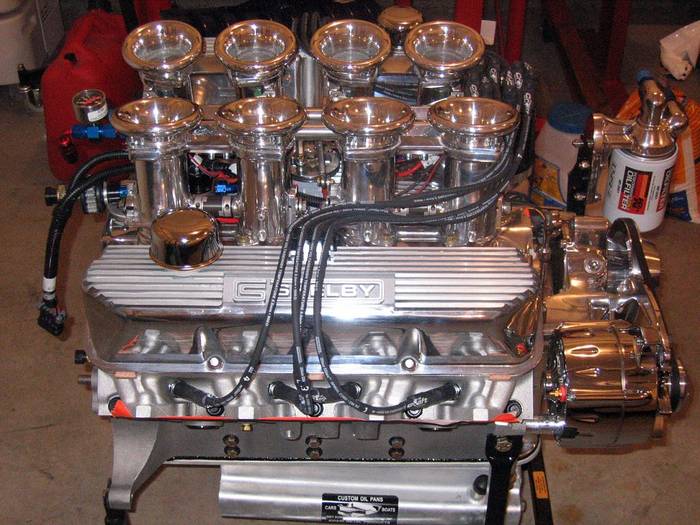
And here's a picture of the engine that I'm currently running with EFI in a different car:
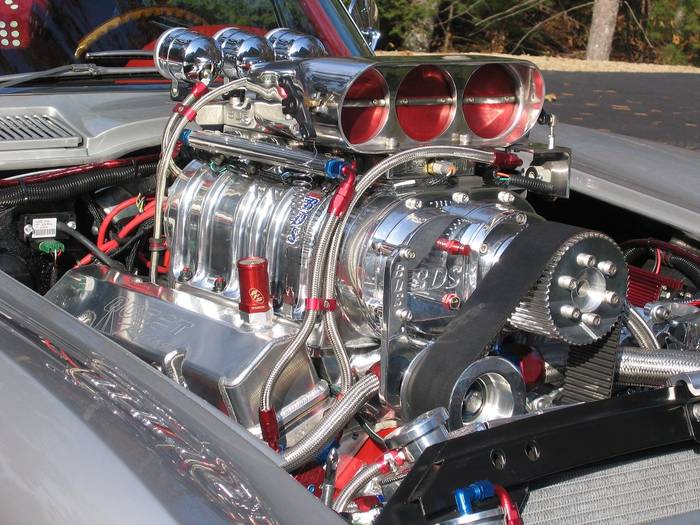
The later motor is a good example of why you might want to consider EFI. The motor in this picture makes 625 HP on pump gas and is completely streetable. It starts and idles like a stock motor (even in cold weather) and it makes a great deal of torque and HP when you open it up. Your ability to properly tune an EFI equipped engine (even a radical one) is much better that you can achieve with carbs. Also, street drivability and throttle response will be better, especially with radical cams, etc.
The computer control that comes with an aftermarket EFI system also opens up some other interesting possiblities. For example, FAST's computer can support electronic traction control. With the addition of a driveshaft speed sensor, the computer can sense when the rear wheels are spinning and it will selectively cut timming and fuel to individual cylinders to keep the rear wheels from spinning excessively. This should be great for cars like the 427 Cobra where applying the torque from a big block is a real challenge. We're going to try this setup on my ERA. Most modern EFI computers have other features that are useful such as power adder controls, boost controls, data recording features (very useful when you are tuning or are trying to troubleshoot problems), etc. You will also gain tremendous control over the details of your motor's operation. For example, blown motors such as the one above are prone to getting hot when they idle for longer periods of time. This is because of the load that the supercharger places on the engine even at idle. For the motor shown above, I was able program the EFI computer to slow the idle speed to about 700 RPM when the water temperature rises above 195 degrees which causes the motor to generate less heat. This motor would not normally idle smoothly at that RPM unless it is fully warm given the camshaft that is installed. This was a great aid in keeping the car cool in traffic.