Rick Parker
Thu April 6, 2006 7:24pm
Rating: 10
|
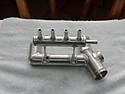
Water/Fuel manifold
A lot of fabrication required to make the welded Fuel/Water Manifold. Lots of fun on the mill & lathe.
|
|

fastraxsg
Fri January 12, 2007 6:35am
|
IMG_7386b
Butt up in the air. Got new Lowell lowered springs but now need to modify chassis so torsion bars don't hit before springs bottom. Had to use spacers to get spring travel but raised body. Major operation required but, now ride is bearable. Local Marvia Cobra, 1989
|
|
turbotadd
Mon February 5, 2007 9:42pm
|
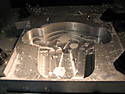
Rear Caliper Brackets
Custom Caliper brackets I just finnished for my TurboCoupe rear, with Ranger Axles. 3/4" offset required a lot of metal removal, no problem for the HAAS.
|
|
Baz
Wed November 7, 2007 1:52pm
|
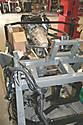
Motor_and_Gearbox_in_chassis_Small_
7.11.07 - The LS2 motor and 6L80E transmission sit in the chassis to establish the optimum positioning of the engine and gearbox mounts. It also allows the gear selector lever to be positioned on the consul as far forward as is required.
|
|

fkemmerer
Thu July 31, 2008 6:02am
|
ERA 753 - Engine Installation
Here's a picture of the engine going in our ERA. Note the tilt back - this is required to get the engine into the engine bay.
|
|
kitcarbp
Thu March 19, 2009 10:30am
Rating: 10
|
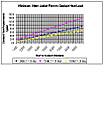
500+ HP Engine Water Jacket Coolant Flow Requirements
This chart shows the linear relationship between the heat rejection (load) of the coolant and the required (calculated) coolant flow in the engine water jacket. It is determined for 3 different temp gradients of the engine inlet and outlet coolant temp. This engine example is from a 500+ horsepower supercharged gas engine assumed to have heat rejection up to maximum power (8,000 btu/min). Why do we care? If you cant keep engine temps under control at speed under load, you may have: 1) insufficient water flow, 2) undersized radiator, or 3) insufficient air flow through the radiator that needs to be addressed. This engine will require coolant flow in the lower part of the curve in street applications (low heat rejection), but for racing/track use this engine will require coolant flow rates towards the top of each curve. For older V8's pre-emissions, the common design target is to keep the radiator Inlet @ 190 F and outlet @ 180F or an average core temp of 185F at steady state conditions or the upper curve shown. Modern engines may use a little higher 195F-185F or rad core avg temp of 190F.
|
|
magda
Fri April 16, 2010 12:57pm
|
Python
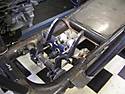
Our uniquie in floor pedal system allows for easy access and more room in the engine bay (no booster required)
|
|

tin-man
Mon April 25, 2011 2:00am
Rating: 10
|
|
tin-man
Mon April 25, 2011 2:00am
Rating: 10
|
|

tin-man
Mon April 25, 2011 2:00am
Rating: 10
|
|
tin-man
Mon April 25, 2011 2:00am
Rating: 10
|
|
Jerry Clayton
Fri April 29, 2011 1:58pm
Rating: 10
|
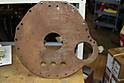
IMG_0128_640x427_
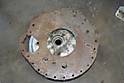
Lakewood housing showing block plate with all the bolt holes for required bolts
|
|
Jerry Clayton
Fri April 29, 2011 2:04pm
Rating: 10
|
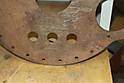
IMG_0132_640x427_
460 Ford Lakewood block plate showing required extra bolt holes and starter surround
|
|
Jerry Clayton
Fri April 29, 2011 2:04pm
Rating: 10
|
IMG_0133_640x427_
Ford block plate showing lower required bolt holes
|
|
Jerry Clayton
Fri April 29, 2011 2:04pm
Rating: 10
|
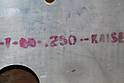
IMG_0137_640x427_
Thickness marking required to be left on plate
also can see that Kaiser alum supplier
|
|