 
 Main Menu
|
|
Nevada Classics
|
|
Advertise at CC
|
| S |
M |
T |
W |
T |
F |
S |
| |
|
|
|
|
1 |
2 |
| 3 |
4 |
5 |
6 |
7 |
8 |
9 |
| 10 |
11 |
12 |
13 |
14 |
15 |
16 |
| 17 |
18 |
19 |
20 |
21 |
22 |
23 |
| 24 |
25 |
26 |
27 |
28 |
29 |
30 |
| 31 |
|
|
|
|
|
|
|
|
CC Advertisers
|
|
 12Likes 12Likes

12-19-2015, 08:55 PM
|
|
CC Member

|
|
|
Join Date: Jul 2008
Location: Driftwood,
TX
Cobra Make, Engine: Contemporary Cobra, 427 side oiler
Posts: 1,850
|
|

 Not Ranked
Don't discount that 160 t-stat being a contributor. Most HP V-8s run at 185-200 normal operating temp. So your 160 thermostat opens once as the car heats up, and never closes again. That's not what you want. If it isn't cycling open and closed over and over then the water isn't staying in the radiator long enough to get that 35-40 degree drop, its just racing through. Car then overheats and stays that way. You need a 180-190 t-stat so that you can create the "heat exchange" properties between the engine and radiator up near the proper operating temp. A weak fan or poorly constructed shrouding can cause this too. Home Depot sells a Bosch handheld infrared temp gun for $40 that will help you nail this problem down in about 10 minutes. Start by measuring the difference between the top hose entry and the bottom exit.
|
12-20-2015, 04:57 AM
|
|
CC Member
|
|
|
Join Date: Feb 2003
Location: Jonesboro GA,
Posts: 382
|
|
Not Ranked

One day I'm going to do a thorough test and disprove once and for all the myth of no tstat causing overheating due to excess flow through the radiator. Last one was proving air was in fact not hotter closer to the track surface.
Keep in mind that radiator sizing is determined by its ability to exchange heat with the air, not the water. Also this is a recirculating system so single pass heat transfer is irrelevant.
Water/metal contact is an efficient heat transfer mechanism while air/water is not, therefore, the radiator is sized based on air heat transfer. For the theory to be correct, it would require the water to pass the radiator so quickly that it couldn't heat the metal within it, which is simply not possible as a moving fluid is more effective at heat transfer than a stationary one. The air passing a radiator simply doesn't care how hot the water is or how fast it is moving, it only cares about the temperature differential between the air and metal. The truth is that the higher the water flow within a radiator, the greater the surface area of the radiator with higher temps and the more effective it is at exchanging heat with the air. Remember, the purpose of the radiator is not to have low temps at the outlet, it is to exchange heat with the air.
Think about it. If moving too fast through a heat exchanger was a detriment to heat transfer, then going too fast would have the same effect due to excess airflow and cars would overheat at high speed. While there isn't a reasonable purpose to running no thermostat on a car, the reality is that it causes overheating is an old wives tale. It's based on anecdotal reasoning from troubleshooting overheating cars with a little confusion regarding single pass heat exchangers vs recirculating systems.
As for the OP's problem: My money is on either the incorrect water pump or that it is using an inline filler in the upper radiator hose to tie into a coolant recovery system. Tying coolant recovery into inline fillers in the upper hose provides poor air removal due to lacking sufficient space for a stable air pocket to form while water is flowing.

|
12-20-2015, 06:05 AM
|
|
CC Member
|
|
|
Join Date: Dec 2015
Location: Houston,
TX
Cobra Make, Engine: FFR, Windsor based 427, naturally aspirated, 770 cfm Holley
Posts: 4
|
|
Not Ranked
Hot Running Windsor based 427 FFR Roadster
Mikeinatlanta, thanks. Agreed on the thermostat and velocity of water through the radiator. It is not the thermostat or in my testing cases the lack thereof. There has been no change in the max. water and oil temperatures with three different or no thermostat conditions. In fact I am now an expert on replacing Ford thermostats I've done it so many times. Water pump for the record is correct from Ford Racing for this engine. Although I have put an overdrive pulley on it to turn it faster. Thought I might be cavitating the pump by doing this with no thermostat installed as the pump is centrifugal and operating well out on its curve. Those were my thoughts. This engine ran on the Ford engine dyno without the high temps and put out 537 hp. Will check timing again and some of the other suggestions and then advise all. Inline filler is high on the outlet hose between block and radiator inlet. Have burped this thing more times than I like to count. I do lose a small mount of fluid into the overfill tank after each test run on the car. So I top it off.
|
12-20-2015, 06:38 AM
|
|
CC Member
|
|
|
Join Date: Feb 2003
Location: Jonesboro GA,
Posts: 382
|
|
Not Ranked
Quote:
Originally Posted by rhunt

Mikeinatlanta, thanks. Agreed on the thermostat and velocity of water through the radiator. It is not the thermostat or in my testing cases the lack thereof. There has been no change in the max. water and oil temperatures with three different or no thermostat conditions. In fact I am now an expert on replacing Ford thermostats I've done it so many times. Water pump for the record is correct from Ford Racing for this engine. Although I have put an overdrive pulley on it to turn it faster. Thought I might be cavitating the pump by doing this with no thermostat installed as the pump is centrifugal and operating well out on its curve. Those were my thoughts. This engine ran on the Ford engine dyno without the high temps and put out 537 hp. Will check timing again and some of the other suggestions and then advise all. Inline filler is high on the outlet hose between block and radiator inlet. Have burped this thing more times than I like to count. I do lose a small mount of fluid into the overfill tank after each test run on the car. So I top it off. |
If you have an inline filler with coolant recovery tapping off of it, I'm betting you still have a bunch of air. Coolant recovery can't remove air unless there is a stable air pocket at removal point. With an inline filler, you tend to only get a bit of air removal at the point that the system is pressurizing but the tstat is still closed and stopping flow past the filler. It will eventually get the air out, but it will be a slow process taking many cycles.
I suggest that you look at a cobra earl's chevy tstat adaptor and a tall chevy filler. It allows a nice air pocket at the top of the system and will turn burping into an easy task. Alternatively, abandon coolant recovery and install a surge tank system.
Here is the CobraEarl's adaptor.

Here is the tall chevy filler that would go on top of it. It gives a nice air pocket at the top of your system for coolant recovery.
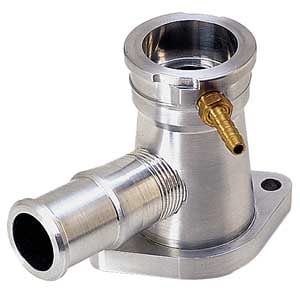
|
12-20-2015, 09:15 AM
|
|
CC Member
|
|
|
Join Date: Jul 2008
Location: Driftwood,
TX
Cobra Make, Engine: Contemporary Cobra, 427 side oiler
Posts: 1,850
|
|
Not Ranked
Quote:
Originally Posted by mikeinatlanta
Think about it. If moving too fast through a heat exchanger was a detriment to heat transfer, then going too fast would have the same effect due to excess airflow and cars would overheat at high speed. While there isn't a reasonable purpose to running no thermostat on a car, the reality is that it causes overheating is an old wives tale. It's based on anecdotal reasoning from troubleshooting overheating cars with a little confusion regarding single pass heat exchangers vs recirculating systems.
|
You are wrong, but you are certainly entitled to your "opinion." A properly constructed heat exchange system with the right thermostat will offset and resolve any notion that higher speeds would in turn escalate heat. That's why it's a heat exchanger. You can call it old wives tales but it takes two of my hands to count how many times I have helped people with overheating engines in cars that operate in the street and the problem was either the wrong thermostat or one missing and nothing else.
I am not here to predict the OP's problem and look smart and cool. My posts generally offer advice based on my experiences. It would appear the OP has ruled out the thermostat anyway.
|
12-20-2015, 09:42 AM
|
|
CC Member
|
|
|
Join Date: Feb 2003
Location: Jonesboro GA,
Posts: 382
|
|
Not Ranked
Quote:
|
Originally Posted by elmariachi;
I am not here to predict the OP's problem and look smart and cool.
|
No need to make it personal. I'm absolutely fine with you being misinformed, just trying to help keep the OP from following in your footsteps.
BTW: Looks like the Stewart Components agrees with my claim, however, no doubt that the misconception that you subscribe to is the prevalent train of thought, no matter how illogical or impossible it may be.
Clip from the Stewart article posted by cycleguy55:
"A common misconception is that if coolant flows too quickly through the system, that it will not have time to cool properly. However, the
cooling system is a closed loop, so if you are keeping the coolant in the radiator longer to allow it to cool, you are also allowing it to stay in
the engine longer, which increases coolant temperatures. Coolant in the engine will actually boil away from critical heat areas within the
cooling system if not forced through the cooling system at a sufficiently high velocity. This situation is a common cause of so-called "hot
spots", which can lead to failures."
EDIT: Don't want to sidetrack the OPs thread, however, I would challenge anyone to provide a single shred of scientific evidence that increasing coolant flow (by removing the thermostat) in a close system will lead to loss of the heat exchanger's ability to function.
Last edited by mikeinatlanta; 12-20-2015 at 09:52 AM..
|
12-20-2015, 10:18 AM
|
|
CC Member
|
|
|
Join Date: Aug 2007
Location: Carlsbad,
Ca
Cobra Make, Engine: SPF 2932 with 438 Lykins Motorsports engine. Previous owner of FFR 5452.
Posts: 2,617
|
|
Not Ranked
I always thought that the original purpose of the thermostat was to recycle warm water through the engine so that it would reach optimal operating temperature quicker. Once that temp was reached, the thermostat would slowly open to increase flow through the radiator to maintain that temp.
Therefore, eliminating the thermostat would only cause the engine to take longer to reach its normal operating temperature.
Is my thinking off?
Now, if you want to solve your problem, jack up the front of your car as high as it will go. Beg borrow or steal a Lisle coolant filler funnel kit. Remove radiator cap, insert funnel, add coolant, start engine and watch the magic. Air bubbles will emerge as your thermostat opens. Once the bubbles stop, turn off engine. Make sure you only put enough coolant in the funnel to cover the tip, as when you shut off the engine, boiling coolant will want to exit your engine and will fill the funnel.
Let cool, then remove funnel and put radiator cap back on. You do have a coolant recovery system in place don't you?
__________________
Jim
Last edited by jhv48; 12-20-2015 at 10:28 AM..
|
12-24-2015, 01:38 PM
|
|
CC Member
|
|
|
Join Date: Dec 2015
Location: Houston,
TX
Cobra Make, Engine: FFR, Windsor based 427, naturally aspirated, 770 cfm Holley
Posts: 4
|
|
Not Ranked
Follow Up - Hot Running Windsor based 427 FFR Roadster
So to respond to several of the comments here is what I checked;
1.) No air in manifold by removing the water temp. sensor. Only water/glycol came out of connection.
2.) Pump rotation is CW when you are positioned in front of the car looking back at the engine. This is the factory rotation.
3.) Timing is set and re-confirmed at 32 BTDC at 4,000 rpm and 12 deg. BTDC at idle
4.) Worried about to 210-215 deg F water temp. because a phone call to Ford Racing tech line stated 180 to 200 deg F. And oil temp is also high. 10 quarts in system currently, pan is 9 quart capacity Also ambient temps here in TX are 65 deg F and from April to Oct will be 95 to 105 deg F.
5.) OD pulley is March P/N 1647 and is the high flow ratio. Pulley would be smaller than stock to turn the pump faster. Was concerned I might be cavitating the pump at the faster speed. Not sure on this yet.
6.) Have ordered original Surge tank from Cobra Restorers in GA for a 427 FE modified to fit the Windsor intake manifold ($375.00 USD). Will install and advise results. Cheers
|
12-24-2015, 03:23 PM
|
|
CC Member
|
|
|
Join Date: Aug 2007
Location: Carlsbad,
Ca
Cobra Make, Engine: SPF 2932 with 438 Lykins Motorsports engine. Previous owner of FFR 5452.
Posts: 2,617
|
|
Not Ranked
My new engine reacted exactly as yours is doing. Temp would go right to 212 and sit there. No fluctuation as the 180 degree thermostat was opening and closing. I used a temp gun to check water temps at various points and they all came back normal, but the temp gauge still read 212 degrees.
Jacked up the front end of the car, installed the Lisle funnel in the radiator inlet and ran the engine till the thermostat opened. Saw a few air bubbles in the funnel. This was my fourth attempt at burping the engine. Continued to run the engine till they stopped and then shut her down and sealed it up when it cooled down. These engines are a bear to burp. Keep trying. It's always the simple things that screw you up.
Now my water temp rarely gets over 180 degrees while driving.
__________________
Jim
|
12-25-2015, 11:34 AM
|
 |
CC Member
|
|
|
Join Date: Apr 2009
Location: Little Rock area,
AR
Cobra Make, Engine: ERA Street Roadster #782 with 459 cu in FE KC engine, toploader, 3.31
Posts: 4,533
|
|
Not Ranked
Quote:
Originally Posted by rhunt
So to respond to several of the comments here is what I checked;
1.) No air in manifold by removing the water temp. sensor. Only water/glycol came out of connection.
2.) Pump rotation is CW when you are positioned in front of the car looking back at the engine. This is the factory rotation.
3.) Timing is set and re-confirmed at 32 BTDC at 4,000 rpm and 12 deg. BTDC at idle
4.) Worried about to 210-215 deg F water temp. because a phone call to Ford Racing tech line stated 180 to 200 deg F. And oil temp is also high. 10 quarts in system currently, pan is 9 quart capacity Also ambient temps here in TX are 65 deg F and from April to Oct will be 95 to 105 deg F.
5.) OD pulley is March P/N 1647 and is the high flow ratio. Pulley would be smaller than stock to turn the pump faster. Was concerned I might be cavitating the pump at the faster speed. Not sure on this yet.
6.) Have ordered original Surge tank from Cobra Restorers in GA for a 427 FE modified to fit the Windsor intake manifold ($375.00 USD). Will install and advise results. Cheers |
I'm not experienced with Windsor motors but based on FE and Chevy motors I would say your timing is borderline retarded and another 3 to 4 degrees of advance might cool your motor down a little - unless you are also running some vacuum advance. |
12-20-2015, 12:21 PM
|
|
CC Member
|
|
|
Join Date: Jul 2008
Location: Driftwood,
TX
Cobra Make, Engine: Contemporary Cobra, 427 side oiler
Posts: 1,850
|
|
Not Ranked
Quote:
Originally Posted by mikeinatlanta
BTW: Looks like the Stewart Components agrees with my claim, however, no doubt that the misconception that you subscribe to is the prevalent train of thought, no matter how illogical or impossible it may be.
|
Wrong again, suggest you go read the first paragraph of the Stewart article, which is what most people who have been around high performance street cars already know: A thermostat is essential in preventing overheating. What Stewart is saying is that WHEN THE THERMOSTAT NEEDS TO BE OPEN.....a faster flowing passage is what you want (vis-a-vis their hi-flow thermostats.) They are then saying that such faster flow is not a bad thing. You are taking that out of context to suggest that it supports your theory that if a hi-flow thermostat is good, then no thermostat at all is better.
Look, it doesn't take a rocket scientist to understand that the two purposes of a thermostat are: 1. Achieve and maintain under all conditions the "optimal" operating temperature for a given engine (to Madmaxx's post above) and, 2. Regulate/control the flow of water/coolant in order to accommodate conditions (like stop and go driving on the street), where airflow across the radiator and water flow from higher RPMS aren't available to assist in creating the needed heat exchange and dissipation. The absence of a proper heat exchange is going to increase the chances of a healthy car overheating, and guarantee an unhealthy car to overheat. Sorry you can't get your head around this.
I tend to agree with the notion the OD pulley is possibly a contributor given you have ruled out the thermostat. Rhunt...is your engine carbureted....are you sure about your mixture tuning? If its running too lean, even by a little, that will drive temps up and nothing will stop it.
|
 Posting Rules
|
You may not post new threads
You may not post replies
You may not post attachments
You may not edit your posts
HTML code is Off
|
|
|
All times are GMT -7. The time now is 06:18 AM.
Links monetized by VigLink
|














 Hybrid Mode

