 
 Main Menu
|
|
Nevada Classics
|
|
Advertise at CC
|
| S |
M |
T |
W |
T |
F |
S |
| |
|
|
1 |
2 |
3 |
4 |
| 5 |
6 |
7 |
8 |
9 |
10 |
11 |
| 12 |
13 |
14 |
15 |
16 |
17 |
18 |
| 19 |
20 |
21 |
22 |
23 |
24 |
25 |
| 26 |
27 |
28 |
29 |
30 |
|
|
|
|
CC Advertisers
|
|
 8Likes 8Likes
-
 2
Post By
2
Post By
-
 1
Post By aa909
1
Post By aa909
-
 1
Post By patrickt
1
Post By patrickt
-
1
Post By patrickt
-
1
Post By jhv48
-
2
Post By

06-12-2021, 01:02 PM
|
|
CC Member

|
|
|
Join Date: Oct 2011
Posts: 163
|
|

 Not Ranked

Quote:
Originally Posted by patrickt

Alternators usually have a ground connection, labeled as such, on the back just like BATT, FLD, or STAT. But not always. And they usually take their ground from their bracket bolt to the side of the block. Snap a pic of the manufacturer's label on the Alternator. You know, like Delco-Remy Model #12345, etc.
And you can't really tell just by looking at a ground whether it's any good or not, or whether you need another one somewhere else. You have to measure the current and do voltage drop tests, which all are very easy to do once you learn how. FWIW, I have more than one ground and continued adding grounds until the current that was passing through each ground cable was down to an amperage level that I liked to see. On the other hand, the car ran fine, and the lights and fans worked fine taking their ground connection off the frame, with only a single 10 gauge ground wire from the head to the firewall/frame. But on the third hand, my amp gauge needle started wavering after a good 10+ years of never doing that. It was cured by adding an additional ground wire to the voltage regulator case to supplement the little ground wire that was in the harness.
|
Hey Patrick
I googled the part # on the back at it's a Powermaster. here's the wiring diagram online

Looks like the small wire is just the "idiot light" on the dash if battery stops charging. The larger red wire goes to the solenoid or battery and I'm clearly missing the ground wire.
So what gauge ground wire should I get, 10 gauge? and can I piggy back it on the same ground on the chassis shown in the post above (the one that goes from the engine to the chassis)?
Interesting that this diagram shows the "ground as optional"
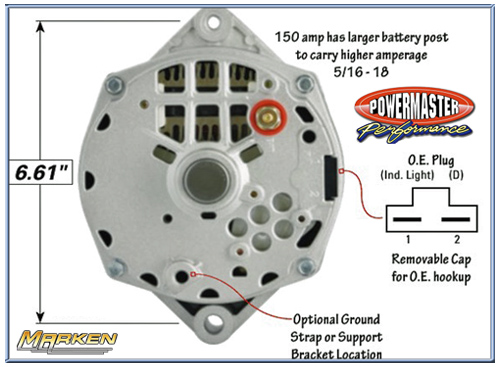
__________________
Thanks
Art
Last edited by aa909; 06-12-2021 at 01:14 PM..
|
06-12-2021, 01:15 PM
|
|
Half-Ass Member
|
|
|
Join Date: Jun 2005
Cobra Make, Engine: ERA #732, 428FE (447 CID), TKO600, Solid Flat Tappet Cam, Tons of Aluminum
Posts: 22,025
|
|
Not Ranked
"One Wire" alternators like yours do not have external voltage regulators, so you don't have to look for one.  I see on the instruction a little bolt hole for a ground strap but I don't see that connected on yours. But that doesn't necessarily mean your alternator isn't sufficiently grounded. To answer that question, put your Volt/Ohm meter on the lowest voltage setting. Then start the car and turn on all the lights, fans, and anything else you have to create electric load. Have someone rev the engine to 2500 RPM and put one lead of your VOM on the negative terminal of the battery and the other lead on the outside case of your alternator. If you read more than .2 volts (or -.2 volts if the leads are reversed) then you need to run a supplementary ground to your alternator. |
06-12-2021, 01:52 PM
|
|
CC Member
|
|
|
Join Date: Oct 2011
Posts: 163
|
|
Not Ranked
Quote:
Originally Posted by patrickt
"One Wire" alternators like yours do not have external voltage regulators, so you don't have to look for one. I see on the instruction a little bolt hole for a ground strap but I don't see that connected on yours. But that doesn't necessarily mean your alternator isn't sufficiently grounded. To answer that question, put your Volt/Ohm meter on the lowest voltage setting. Then start the car and turn on all the lights, fans, and anything else you have to create electric load. Have someone rev the engine to 2500 RPM and put one lead of your VOM on the negative terminal of the battery and the other lead on the outside case of your alternator. If you read more than .2 volts (or -.2 volts if the leads are reversed) then you need to run a supplementary ground to your alternator. |
Thanks Patrick, you've been tremendously helpful. However my battery is in the trunk, is there another spot I can use to check the Voltage drop?
In any case I'll have to wait till later (when I have a helper) to run this test, but I assume from what I've shared here I can drive the car in the current state without risking any "damage" to the electric system?
Thank you!
__________________
Thanks
Art
|
06-12-2021, 01:58 PM
|
|
Half-Ass Member
|
|
|
Join Date: Jun 2005
Cobra Make, Engine: ERA #732, 428FE (447 CID), TKO600, Solid Flat Tappet Cam, Tons of Aluminum
Posts: 22,025
|
|
Not Ranked
Just run a long wire, a lamp cord cut up and spliced together will do nicely, but run it to the negative terminal of the battery. There are short cuts, but they often mislead you. If you really do need a supplementary ground at the alternator, then your VOM might read a half volt or even one volt. One volt would be a lot. But by all means drive your car. At this point you are only optimizing; you're not fixing anything that's really broken. FWIW, when I run a VOM from the alternator case to the negative terminal of my battery I read .05 volts.
|
06-12-2021, 02:30 PM
|
|
CC Member
|
|
|
Join Date: Oct 2011
Posts: 163
|
|
Not Ranked
Quote:
Originally Posted by patrickt
Just run a long wire, a lamp cord cut up and spliced together will do nicely, but run it to the negative terminal of the battery. There are short cuts, but they often mislead you. If you really do need a supplementary ground at the alternator, then your VOM might read a half volt or even one volt. One volt would be a lot. But by all means drive your car. At this point you are only optimizing; you're not fixing anything that's really broken. FWIW, when I run a VOM from the alternator case to the negative terminal of my battery I read .05 volts.
|
Perfect, I’ll go ahead and run the wire as you noted. Thanks again!
__________________
Thanks
Art
|
06-13-2021, 07:50 PM
|
|
CC Member
|
|
|
Join Date: Aug 2007
Location: Carlsbad,
Ca
Cobra Make, Engine: SPF 2932 with 438 Lykins Motorsports engine. Previous owner of FFR 5452.
Posts: 2,617
|
|
Not Ranked
One wire alternators are grounded to the engine block by the mounting bolts that hold it in place to the engine block. No additional grounding wires are needed. Your alternator is correctly installed and wired as is. Hence the name “one
Wire alternator”.
__________________
Jim
|
06-14-2021, 05:12 AM
|
|
Half-Ass Member
|
|
|
Join Date: Jun 2005
Cobra Make, Engine: ERA #732, 428FE (447 CID), TKO600, Solid Flat Tappet Cam, Tons of Aluminum
Posts: 22,025
|
|
Not Ranked
Quote:
Originally Posted by jhv48
One wire alternators are grounded to the engine block by the mounting bolts that hold it in place to the engine block. No additional grounding wires are needed. Your alternator is correctly installed and wired as is. Hence the name “one Wire alternator”.
|
Sometimes mounting bolt brackets are powder coated, sometimes brackets are painted, sometimes the fasteners at the block or water pump are slathered up with RTV, sometimes there's a plastic washer between the fasteners, sometimes there's a rubber insulator.... The only way you can tell if a ground is really good or not is to measure it under load. Or, you can take a shortcut and just eyeball it and say "yeah, that looks like a pretty good ground to me." But you have to measure it under load. Just like measuring the resistance of a filament in a light bulb -- you have to do it when the bulb is lit, otherwise they all read 0 ohms.  |
 Posting Rules
|
You may not post new threads
You may not post replies
You may not post attachments
You may not edit your posts
HTML code is Off
|
|
|
All times are GMT -7. The time now is 04:41 AM.
Links monetized by VigLink
|















 Hybrid Mode

