 
 Main Menu
|
|
Nevada Classics
|
|
Advertise at CC
|
| S |
M |
T |
W |
T |
F |
S |
| |
|
|
1 |
2 |
3 |
4 |
| 5 |
6 |
7 |
8 |
9 |
10 |
11 |
| 12 |
13 |
14 |
15 |
16 |
17 |
18 |
| 19 |
20 |
21 |
22 |
23 |
24 |
25 |
| 26 |
27 |
28 |
29 |
30 |
|
|
|
|
CC Advertisers
|
|
 6Likes 6Likes

10-11-2018, 11:41 AM
|
 |
CC Member

|
|
|
Join Date: Apr 2004
Posts: 1,033
|
|

 Not Ranked

Quote:
Originally Posted by Karl Bebout

Is that a tach drive off the generator? WTF? There were electronic Tachs back then, weren't there? Sun with a sending unit box?
Also, is that a 5th breather cap beside the generator, by the dip stick?
|
Yes, early Cobras used Lucas® race prepared tachometer drive generator supplied by AC Cars with the chassis. The original assemblies had one of a couple of different large diameter one piece cast aluminum fan and sheave for high rpm use. I believe AC Cars and or Ken Rudd had used the same type racing generator system on ACEs and RS2.6s before Cobras. Very few early cars still have their original generator with large diameter cast aluminum fan/sheave. There was a gear box that was assembled between the generator and cable. (I believe that COB/COX60xx cars for the British and European markets used the Lucas tachometer drive generator assembly and large cast aluminum style fan / sheave all the way through the end of production with 289 engines. Roger can you confirm?)
At some point after CSX2061 and by CSX2080 chassis started receiving a Ford electrically operated tachometer. The hole the instrument panel cut for a Smiths tachometer was too large for the Ford instrument so special stepped steel adpater rings painted gloss black were used to make the smaller outer diameter Ford instrument "fit".
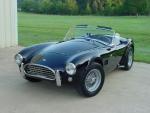
Early XHP-260 powered Cobra unrestored with intact racing Lucas generator.
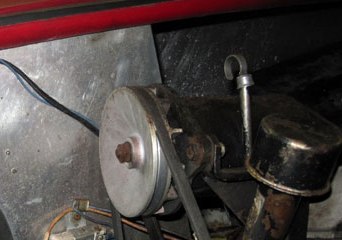
AC Cars supplied the Lucas generators, a custom fabricated mounting bracket, and an adjustable slip arm to v-belt tension adjustment. Those early charging systems are associated with early cars originally fitted with either a XHP-260 or HP260 engine. The introduction of HP289 engines at the beginning of March 1963 brought in the Ford charging system Ford used in Fairlanes with HP289 engines.
1962 (XHP-260 and HP260) engines and 1963 HP289 engines did not have any accessory ports in rocker arm covers as Ford built them. Crankcase ventilation and oil fill was through an oil fill tube in the timing cover. Ford (and Cobra) wise the oil fill location in street engines was moved to a rocker arm cover and the oil fill tube in the timing cover was eliminated for the 1964 model year. The hole Ford made in the front wall of the lifter valley to create a path between timing cover oil fill / breather was soon dropped from production. If one uses a 1962-63 oil fill/ventilation through the timing system on a 1964 or later model year engine block a hole must be drilled in the front wall of the lifter valley UNLESS you find a service block that Ford drilled the passage and then pressed a core plug into it. If a core plug is present it can be knocked out to allow use of the timing cover fill/ventilation system.
For race engines Shelby American added one or more ventilation features. Every engine and car was a similar but different subject as drivers and subteams of mechanics had different preferences. Said another way each set of modified rocker arm covers were usually just a little different than any other set. Items like oil pans and rocker arm covers were modified by different people at different times under different sets of preferences as required. It was not like ordering production or assembly line parts from a catalog. Mechanics made what they wanted as they needed it. For restoring original race cars it would be a historical mistake to have every car from every period use the exact same rocker arm covers today.
Even the way original Shelby American race shop modified steel rocker arm covers were finished varied: some where painted silver, some were painted dull black, some where painted high gloss black, and later ones usually bright cadmium plated. Some engines used either standard Ford painted (CSX2155 for example) or Ford chrome plated dress up (CSX2345 for example) oil fill covers on both sides. At least some of the Dragonsnakes used 1964 version cast aluminum COBRA POWERED BY FORD oil fill side rocker arm covers on both sides of their engines.
Also no "Cobra" subject is simple !
__________________
Dan Case
1964 Cobra owner since 1983, Cobra crazy since I saw my first one in the mid 1960s in Huntsville, AL.
Last edited by Dan Case; 10-11-2018 at 02:12 PM..
Reason: add detail
|
10-11-2018, 04:58 PM
|
 |
CC Member
|
|
|
Join Date: Nov 2004
Location: Cambridge, England,
n/a
Cobra Make, Engine: 289 leafspring, r/p
Posts: 518
|
|
Not Ranked
As ever, Dan has it all in his post - the little I can contribute is that the dynamo used for UK-market 289s was a Lucas C40T, the 'T' standing for 'with tachometer drive'. Hawk Cars can provide the correct mounting bracket for this dynamo. I don't know if C40Ts are available without a core unit - they might well be - but Wosp (AES) do sell a 'Dynator' version, which is an alternator within an (aluminium, not iron) casing (you lose the engraved detail on the original style of casing). This can be used with ammeter and all original wiring in conjunction with Dynalite's dummy Lucas RB360 control box, there is just one small wiring change that is difficult to spot (Dynalite change the internals of the RB360 to suit, which incorporates a 'whole system' 50A fuse concealed within). NB - I am talking about the Lucas wiring found in UK cars, not the Ford wiring found in CSX cars. It's also worth noting that whilst US market cars may have changed to Ford wiring in '62-3, COB6029 (Haynes Museum, late '64 car) has the Lucas dynamo setup, so I'd say UK cars stuck with the cable tachometer.
As Dan says, cars fitted with the C40T dynamo had cast aluminium pulleys peculiar to Cobra applications. There appear to be two types: a large diameter pulley for street use, and an even larger one for competition use, presumably to reduce power consumption at high revs. Hawk have had a few of both types made.
Cars with the dynamo also used a reduction gearbox screwed to the output connection. This was identical to the Frogeye Sprite unit, now reproduced and readily available from AH suppliers (but I had to turn down an internal bushing on mine as the clearance to a circlip was incorrect, producing a screeching sound until modified - easy enough, but annoying to have to do it). A Healey tacho cable (although LHD for a RHD Cobra) works fine.
The tacho itself is tricky. There are no reproduction tachos and speedos currently manufactured that are even close for a 289 leafspring Cobra (not 100% sure about coilers, but likely to be the same), all being electronic, wrong face design, wrong pointer, no high beam light etc. etc. The best option I have found for a cable drive tacho with a high beam red lens is from a Sunbeam Rapier, with face reprinted by either Speedycables or Speedograph Richfield etc. to the correct design, part numbers, ratio number etc. If you find one of these, convert it and fit it, you will have to find the speedometer to match also. The shape of the dial face and the design of pointer are completely different from the repro instruments which, as noted above, are not correct.
I hope that adds a little to Dan's information,
Roger
|
10-11-2018, 06:01 PM
|
|
CC Member
|
|
|
Join Date: Apr 2004
Posts: 1,033
|
|
Not Ranked
Thanks Roger.
__________________
Dan Case
1964 Cobra owner since 1983, Cobra crazy since I saw my first one in the mid 1960s in Huntsville, AL.
|
10-12-2018, 02:14 PM
|
 |
CC Member
|
|
|
Join Date: Jun 2001
Location: Mesa,
AZ
Cobra Make, Engine: ERA #2119 289FIA
Posts: 5,380
|
|
Not Ranked
Has anyone seen SBF valve covers that look like the steel original type but are actually cast aluminum? Thinking they would clamp down better than the semiflexible steel.
__________________
Karlos
"In the Land of the Pigs, The Butcher is King"
|
10-12-2018, 03:19 PM
|
|
CC Member
|
|
|
Join Date: Nov 2004
Location: Cambridge, England,
n/a
Cobra Make, Engine: 289 leafspring, r/p
Posts: 518
|
|
Not Ranked
I've never had a problem with steel rocker covers. I use cork gaskets, which I glue to the covers with impact adhesive, then apply a thin smear of grease to the cork before installing with the stock screws. Never had a leak, and the gasket lasts for several removal/refit operations. The key is not to overtighten.
Edit - but no, I've never seen cast ones that look like stamped ones.
|
| Thread Tools |
|
|
| Display Modes |
Rate This Thread |
 Hybrid Mode Hybrid Mode
|
|
 Posting Rules
|
You may not post new threads
You may not post replies
You may not post attachments
You may not edit your posts
HTML code is Off
|
|
|
All times are GMT -7. The time now is 01:01 AM.
Links monetized by VigLink
|