 
 Main Menu
|
|
Nevada Classics
|
|
Advertise at CC
|
| S |
M |
T |
W |
T |
F |
S |
| |
|
|
1 |
2 |
3 |
4 |
| 5 |
6 |
7 |
8 |
9 |
10 |
11 |
| 12 |
13 |
14 |
15 |
16 |
17 |
18 |
| 19 |
20 |
21 |
22 |
23 |
24 |
25 |
| 26 |
27 |
28 |
29 |
30 |
|
|
|
|
CC Advertisers
|
|

08-21-2010, 10:52 AM
|
|
CC Member

|
|
|
Join Date: May 2006
Location: St. Louisville,
Oh
Cobra Make, Engine: A&C 67 427 cobra SB
Posts: 2,446
|
|

 Not Ranked
Picture didn't work for me.
The extra time to clay the intake valve would have been fairly small.
If you mock it up with a light spring on the valves, you can measure clearance with a dial indicator by pushing the valve in until it touches the piston. You repeat at many different crank positions. Then you know when the valve is at its closest point.
I would think that the push rods would bend before a piston rod. If the push rods are all straight, the valve may have been kissing the piston fairly light. Hopefully the connecting rods will be fine. Does the top half of the rod bearings look normal?
I would think a good shop could check the rods for you. I would think at reasonable price.
|
08-21-2010, 11:48 AM
|
 |
CC Member
|
|
|
Join Date: May 2001
Location: California,
Ca
Cobra Make, Engine: NAF 289 Slabside Early Comp Car with 289 Webers and all the goodies. Cancelling the efforts of several Priuses
Posts: 6,592
|
|
Not Ranked

The picture did not open for me either but I can imagine small 1/3 circular bright marks in the valve reliefs. Its doubtful the rods are hurt as it would rock the piston if it was a very minor interferance or it would have been quite audible (ie: loud) and never driven after initial startup. I have seen too where on occasion if the engine is over reved the rods will momentarily strech and allow the valves to hit the piston. This is why a specific minimum clearance is set depending on application, valve springs, anticipated RPM etc.
Example: I had a Datsun 510 AutoX car several years ago with a real well built OHC 1800 13:1 domed Venolia pistons, (2) 45 DCOE carbs big cam, crank fired ignition 8000+ RPM engine. Fun car to drive. I missed a shift once and buzzed it to about 8500-8700. It immediatly began to run poorly on only 3 cylinders. I thought I had bent a valve but realized it didn't have any bad mechanical noises. After investigation what had happened was the rod had stretched momentarily and hit the ground electrode on the plug and closed it up. After replacing the plug it ran fine.
__________________
Rick
As you slide down the Banister of Life, may the splinters never be pointing the wrong way 
|
08-21-2010, 03:49 PM
|
|
CC Member
|
|
|
Join Date: Mar 2001
Location: E BRUNSWICK N.J. USA,
Posts: 3,841
|
|
Not Ranked
Have a couple of questions
CobraV8 Simon, to start with, I couldn't open the picture.
Here comes the questions, What is the piston clearance to the deck of the block? Was the deck of the block cut to straighten? Where the heads machined down? What is the crush of the head gaskets? That camshaft should not have hit the pistons unless some of these machine operations where done to the block or heads. Was the camshaft setup correctly? Some camshaft come with a 4 degree advance built into them.
If you drove the motor 5k miles before fining this problem, it sound like a over rev issue with the motor. When the block and heads are cold it is alot more possible to have an interference issue than when hot. This also depends on the material the block and heads are made from. Aluminum expands faster and larger than iron.
As far as repair of the motor, rods and pistons to start should be replaced. A hit is a hit. If you put the rod through the block the party is completely over. Have the crank checked for balance and cracks. You could have the rods checked for length, cracks, and have new bolts installed. Pistons will need to be checked for pin play, damage to the bottom of the skirts hitting the cylinder walls. Clearance and trueness of the bores in the block.
Where the edelbrock heads in stock form? There should be no valve contact with a cam under .575" total lift unless machine work. The other issue could be the valve springs are not the correct ones for the camshaft. It is real easy to not have the correct spring pressures, open and closed. High rpm could have the valves floating and hitting the pistons. If you have the stock springs from edelbrock, and a high rpm range of 6,500 a smacking is very possible. Like others have said, rebuild, repair, and make sure the valve train is up to the rpm range you want to run. You will need new valve springs if you are changing the camshaft any way. Much camshaft companies will give you a listing of what pressures to use for the valve springs in the closed and open postions. Check coil bind too. You can run as small as .060" but this IMO is too tight. I run .090" min. Good luck. Rick L.

|
08-22-2010, 03:19 AM
|
|
CC Member
|
|
|
Join Date: Jan 2004
Location: Shawbury,
Posts: 325
|
|
Not Ranked
Here's the picture again, I hope it works this time:
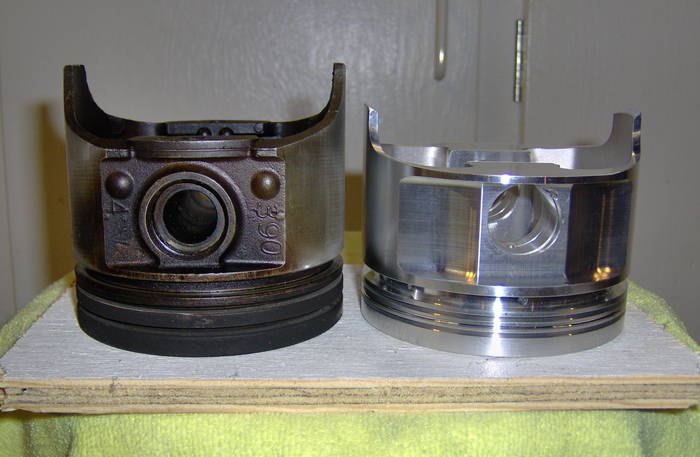
The heads were new when I purchased them and are not milled, as well as the block.
Pistons are flat top TRW , head gaskets Fel-Pro #8548-pt 1 (0,047" compressed)
The camshaft is an Edelbrock Performer RPM, valve springs are the correct ones for this cam. I isntalled the cam straight up and checked it with a degree wheel.
I did not expect any problems as all the components are sold as a matched kit by Edelbrock. They even had an engine build sheet on their homepage using exactly the same head gaskets and pistons. CR is 9.5:1, so this is a fairly mild street engine.
The RPM range of this camshaft goes up to 6500 according to Edelbrock, so the springs should take this RPM. Pushrods were hardened Trick Flow. However in case of over revving the engine I'd also expect the exhaust valves to hit the pistons first?
The engine was still running strong, I did not notice anything that sounded not normal.
I will disassemble the bottom end next and take pics of the bearings. Pushrods looked straight, I will check them again on a glass plate.
Last edited by CobraV8; 04-11-2024 at 02:51 AM..
|
08-22-2010, 04:02 AM
|
|
CC Member
|
|
|
Join Date: Mar 2001
Location: E BRUNSWICK N.J. USA,
Posts: 3,841
|
|
Not Ranked
You over revved the motor and---
CobraV8 Simon it looks like you hydro locked the lifters and got contact on the intake valves. All the marks are new??? As far as the exhaust valves, they are smaller and where clearing inside the piston cuts. Unless you have anti pump up lifters you will have this problem again with a 6,300 rpm range. Fly cut the piston tops is the only way to fix this. I don't know what method you use to adjust lifters. I run hydro roller lifters with a .015"-.017" plunger setup. I also have a 65-80 psi oil pressure system. My lifters pump up at about 5,700 rpms. I do goto 6,200 rpm max. There is no damage from the lifter because of the clearance differents. If you turn down adjusters to spec, 1 -1.5 turns after contact, This is what cause the damage. At lower rpms, the oil is bleeding out of the lifters to stop valve to piston contact. You said you degreed the camshaft. Some timing chain setups have advance or retard built into them. Edelbrock likes their own parts used as a whole from heads,intake,camshaft,lifters, timingchain kit, and distributor gear. BECAREFUL with running a polygear. It needs good lube between the camshaft gear and itself for cooling as well and lubing gear contact area. Setup of the distributor end play also needed. Check camshaft end play too. I think you will find that the damage depth on the pistons is about .020-.030". This would be about the correct distance the plunger in the lifter would be between normal running and pump up. Rick L. They sell a piston cutter for doing this with a drill. Google it or check Jeg's or Summit. I think they both can get of carry this tool. Rick L.
|
| Thread Tools |
|
|
| Display Modes |
Rate This Thread |
 Hybrid Mode Hybrid Mode
|
|
 Posting Rules
|
You may not post new threads
You may not post replies
You may not post attachments
You may not edit your posts
HTML code is Off
|
|
|
All times are GMT -7. The time now is 05:09 PM.
Links monetized by VigLink
|