 
 Main Menu
|
|
Nevada Classics
|
|
Advertise at CC
|
| S |
M |
T |
W |
T |
F |
S |
| |
|
|
|
|
1 |
2 |
| 3 |
4 |
5 |
6 |
7 |
8 |
9 |
| 10 |
11 |
12 |
13 |
14 |
15 |
16 |
| 17 |
18 |
19 |
20 |
21 |
22 |
23 |
| 24 |
25 |
26 |
27 |
28 |
29 |
30 |
| 31 |
|
|
|
|
|
|
|
|
CC Advertisers
|
|

12-06-2009, 05:10 PM
|
 |
CC Member

|
|
|
Join Date: Apr 2009
Cobra Make, Engine:
Posts: 177
|
|

 Not Ranked
I just rebuilt a set of three ida's on a lancia stratos and the bypass screws were there. But I have seen aftermarket or replacement webers without them.
|
12-06-2009, 05:14 PM
|
 |
CC Member
|
|
|
Join Date: May 2006
Location: Portland,
OR
Cobra Make, Engine: ERA FIA, 1964 289->Webers
Posts: 3,689
|
|
Not Ranked
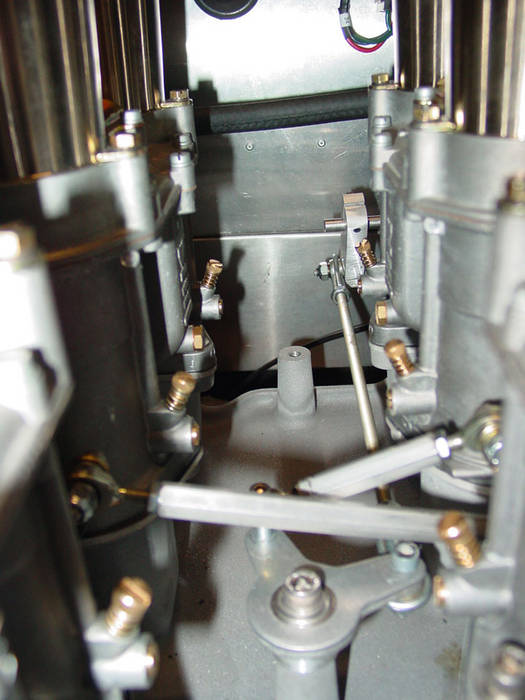
My Ida's do not. This is what we see. I'm under the belief that the Idle jet carrier needs to be replaced to get more air flow?
__________________
ERA FIA 2088
Last edited by *13*; 12-06-2009 at 05:20 PM..
|
12-06-2009, 05:22 PM
|
|
CC Member
|
|
|
Join Date: Apr 2009
Cobra Make, Engine:
Posts: 177
|
|
Not Ranked
I have been servicing and restoring ferrari's for twenty years and they all have them, even a riva ferrari boat that I rebuilt the ida's (eight in total) on two btm engines and they had them. You may have to drill a hole in the trottle plate of the carb with the lower draw reading or if the carbs are old and the throttle shafts are worn the venturi body may be worn and the air is bypassing the throttle plate. If the body is worn the carb may be srcap
|
12-06-2009, 05:26 PM
|
|
CC Member
|
|
|
Join Date: Apr 2009
Cobra Make, Engine:
Posts: 177
|
|
Not Ranked
idle jet controls fuel flow not air flow.
|
12-06-2009, 05:29 PM
|
|
CC Member
|
|
|
Join Date: May 2006
Location: Portland,
OR
Cobra Make, Engine: ERA FIA, 1964 289->Webers
Posts: 3,689
|
|
Not Ranked
There is no other adjustment on the bottom of the carb. This may be a newer development in the 48IDA. I bought mine new a few years back. I wish there was. Would be nice to be able to adjust the air.
__________________
ERA FIA 2088
|
12-06-2009, 05:36 PM
|
|
CC Member
|
|
|
Join Date: Apr 2009
Cobra Make, Engine:
Posts: 177
|
|
Not Ranked
that adjustment will make the car idle so much smoother that it will now with the idle number all over the place. Which air flow gauge are you using?
|
12-06-2009, 05:40 PM
|
|
CC Member
|
|
|
Join Date: May 2006
Location: Portland,
OR
Cobra Make, Engine: ERA FIA, 1964 289->Webers
Posts: 3,689
|
|
Not Ranked
Just the Vacuum in the horn Gauge. It's pretty consistent. I hear the older versions were terrible. My car Idles fine. The barrels aren't off by much. Being nit picky, I'd like to see them exactly even though.
__________________
ERA FIA 2088
|
12-06-2009, 07:06 PM
|
|
CC Member
|
|
|
Join Date: Apr 2009
Cobra Make, Engine:
Posts: 177
|
|
Not Ranked
your correct ida's don't, idf's do, same basic carb body. Ferrari 365bb and 512bb use four ida 3's and they have the bypass screw.
|
12-06-2009, 10:06 PM
|
|
CC Member
|
|
|
Join Date: Mar 2009
Cobra Make, Engine:
Posts: 35
|
|
Not Ranked
OK. I pulled them tonight and realized that I did a bit of a rookie move. These are all Italian IDA that I bought used from various places. In rebuilding them, I did not keep the butterflys with the same carbs. No big deal... right? Well tonight I realized that some of the butterflys had been drilled with an idle correction hole and others had not. So when I reassembled them, you guessed it, I wound up with some carbs with one butterfly that was drilled and one that was not in the same carb.
So now.... do you guys run these holes? These are small (about 1mm) holes in the butterflys at the opposite site from the progression holes. I have enough butterflys that have the holes to make them all the same, but with the idle so high, I am tempted to solders these holes up.
Thanks,
Mark
|
12-06-2009, 06:11 PM
|
 |
CC Member
|
|
|
Join Date: May 2001
Location: California,
Ca
Cobra Make, Engine: NAF 289 Slabside Early Comp Car with 289 Webers and all the goodies. Cancelling the efforts of several Priuses
Posts: 6,592
|
|
Not Ranked
racco- The Idle air bleeds are OEM on the 40/42/46 IDA 3C Weber (3bbl) Carb used on Porsche and on some other applications (perhaps Ferrari as well). They have never been a part of the 48IDA 2bbl. The bodies do not have any undrilled bosses that could be utilized. Is it possible you have this carb confused with the IDF speced for the Lancia Stratos V6 Dino engine, they DO have the air bleed in question.
__________________
Rick
As you slide down the Banister of Life, may the splinters never be pointing the wrong way 
Last edited by Rick Parker; 12-06-2009 at 06:29 PM..
|
12-06-2009, 05:16 PM
|
 |
CC Member
|
|
|
Join Date: Feb 2007
Location: Scottsdale,
Az
Cobra Make, Engine: ERA FIA #2119
Posts: 310
|
|
Not Ranked

this is from the Ingelese site;
For the sake of simplicity, let's look at the Weber carburetor as having three basic circuits- the idle circuit, the accelerator pump circuit and the main circuit.
The idle circuit is comprised of two components, the idle jet and the idle jet carrier. With these two pieces, the tuner can select exactly how much fuel and how much air he wants to provide the engine at idle and during the low rpm operation, while making very fine adjustments to either, if necessary. The idle mixture is delivered as a proportioned mixture whose total volume can be further regulated with the idle mixture screw, which is located on the lower part of each carburetor barrel. On a correctly-jetted idle circuit, the mixture screw on a 48 IDA is never more than 3/4 of a turn out. This will hold true 100% of the time, no matter what anyone else tells you. If you have to go more than that, you'd better heavy-up the idle jet. Even if you get it to idle, going more than 3/4 turn tells you the jet is lean and you're going to have other drivability problems, which brings us to the next part of the idle jet's function.
The idle circuit in the Weber isn't just an idle circuit - it does more than that. It is actually the circuit which must carry the engine all the way up to about 2,800-3,000 rpm, where the transition to the main circuit take place. That means if you don't drive over 3,000 rpm, you're only running on the idle jets. After 3,000 rpm or so, the idle circuit is entirely bypassed and no longer has anything to announce. So, if you have a tuning problem that "goes away" after about 3,000 rpm, that tells you to play with the idle circuit. Or maybe the opposite is true. Either way, it's very cut and dried as far as the two circuits are concerned - so isolating the problem is a breeze.
One the most frequently experienced "gremlins" with Weber carburetors is a seemingly incurable and very annoying flat spot which rears its ugly head at about 2,200-2,800 rpm. This condition is generally caused by one of two things - you either have the wrong emulsion tube in the carburetor, which is causing a rich stumble due to an under-emulsified mixture at that particular rpm range or the idle circuit is falling off too early to carry the engine up to the point where the main circuit can take over, leaving a "lean hole". In simple terms, the idle circuit is going lean too early. Either condition is easily rectified. In the case of the emulsion tube, there are really only a few which work really well for V8 applications; and if you aren't using one of them it is certainly a big part of the problem. If the flat spot is still there even with the correct emulsion tube, then you'll need to richen up the idle circuit. This is sometimes a tricky area, because the first thing you want to do is throw in a bigger idle jet, but sometimes playing with air bleeds, mixture screws, or choke sizes can accomplish the same thing while sticking with the original jet size. Seeking a little bit of sound advice here can save a lot of time and hassle. The point here is that these carburetors are designed to come off idle and run smoothly all the way up. Your problems can be solved with a little tuning on your own or by relating the symptoms to someone who is knowledgeable enough to help you. Remember, these carburetors will do just about anything you want them to, except maybe wash your socks.
The accelerator pump circuit, just like on any carburetor, is responsible for eliminating "bog" and making a passing maneuver without a hesitation or stumble. The circuit also has two basic elements. These are the pump exhaust valve and the pump jet. The pump exhaust is nothing more than a bypass valve and this is located in the bottom of the float bowl. This is the piece that regulates how much fuel you want to make available when you need that pump shot. Putting a bigger bypass hole in the valve allows more fuel to bleed back into the float bowl instead of out of the shooters. The smaller the hole, the more fuel you're making available. You can even put in a "closed" bypass for drag racing, when you need all the juice you can get in order to get those slicks turning. Obviously, there is nothing complicated about a simple bypass system. The duration of the pump shot is varied by installing a larger or smaller pump jet (shooter). Larger pump jets give a heavy blast over a short period, while the smaller ones will give a finer, longer-duration shot. As long as you leave the bypass valve alone, you're still getting the same overall volume. In most cases, the stock pump jets can be left alone.
Don't know it helps but is a great article.

|
| Thread Tools |
|
|
| Display Modes |
 Hybrid Mode Hybrid Mode
|
 Posting Rules
|
You may not post new threads
You may not post replies
You may not post attachments
You may not edit your posts
HTML code is Off
|
|
|
All times are GMT -7. The time now is 09:46 PM.
Links monetized by VigLink
|