Welcome to Club Cobra! The World's largest
non biased Shelby Cobra related site!
- » Representation from nearly all
Cobra/Daytona/GT40 manufacturers
- » Help from all over the world for your
questions
- » Build logs for you and all members
- » Blogs
- » Image Gallery
- » Many thousands of members and nearly 1
million posts!
YES! I want to register an account for free right now!
p.s.: For registered members this ad will NOT show
 
 Main Menu
|
|
Nevada Classics
|
|
Advertise at CC
|
|
April 2026
|
| S |
M |
T |
W |
T |
F |
S |
| |
|
|
1 |
2 |
3 |
4 |
| 5 |
6 |
7 |
8 |
9 |
10 |
11 |
| 12 |
13 |
14 |
15 |
16 |
17 |
18 |
| 19 |
20 |
21 |
22 |
23 |
24 |
25 |
| 26 |
27 |
28 |
29 |
30 |
|
|
|
|
CC Advertisers
|
|

05-23-2010, 04:25 AM
|
 |
CC Member

|
|
|
Join Date: Nov 1999
Location: Brisbane, Australia,
Q
Cobra Make, Engine: Contemporary CCX3117 427FE
Posts: 4,381
|
|

 Not Ranked
 Nascar vs F1 engine comparison...
For the tech-heads, there are some fascinating details in this article that provide an insight into engine forces that I haven't seen before...
http://www.epi-eng.com/piston_engine..._cup_to_f1.htm
__________________
Craig
|
-
Advertising

05-23-2010, 06:53 AM
|
 |
CC Member
|
|
|
Join Date: Aug 2002
Location: Brisbane Australia,
Qld
Cobra Make, Engine: Now built a race cobra.
Posts: 433
|
|
Not Ranked
 I like.
Thanks Craig i enjoyed reading that puts a dent in the old adage about push rod engines cant keep up with multi valve engines. imagine how much power a f1 engine would make at 358 ci.
i will let you do the sums its late.
oz.  |
05-23-2010, 07:25 AM
|
|
Senior Club Cobra Member
|
|
|
Join Date: Jul 2002
Cobra Make, Engine:
Posts: 15,712
|
|
Not Ranked
Thats a very meaty and interesting article, I had to read it slowly, carefully. 
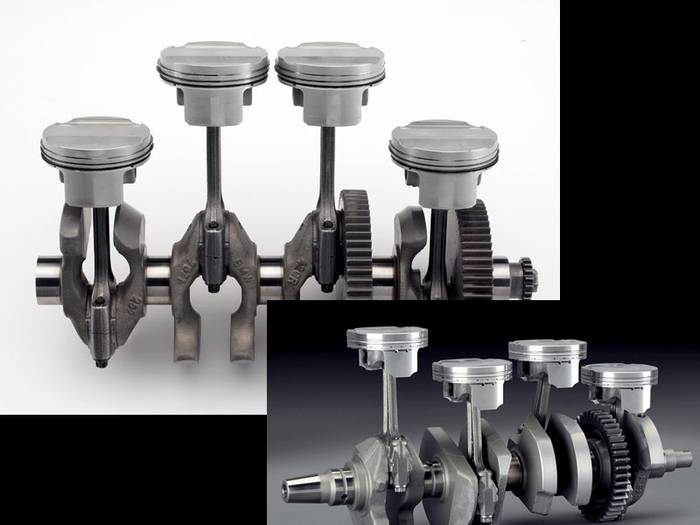
One thing it brought to mind is the fundamental difference between a cross plane and a flat plane crankshaft. Most American V8's (NASCAR) are cross plane (90 degree) while many, if not most, "exoctic" cranks (like Ferrari) are flat plane (180).
Cross plane requires heavier offset weights for balance and are slower to rev up and down than flat plane. While flat plane tend to have balance problems often addressed by a counter rotating balance shaft. The lighter weight of a 180 crank allows for quicker engine revs.
The cross plane also has inherent problems with exhaust flow interference's that lead to such things as the "bundle of snakes" found on the GT-40. While the flat plane has a more easily managed exhaust flow dynamics.
An early racing trick with the Ford flat head V8 was to change from a cross plane to a flat plane crankshaft. The engine vibrated a lot, but ran like stink.
This picture might help with the 90 degree vs 180 degree crank throw positions. Note the difference in crank offset weights as well. One fires every 90 degree's of rotation. The other, every 180 degree's.
Last edited by Excaliber; 05-23-2010 at 07:28 AM..
|
05-23-2010, 12:28 PM
|
 |
CC Member
|
|
|
Join Date: Feb 2006
Location: Gore. New Zealand.,
SI
Cobra Make, Engine: DIY Coupe, F/T ,MkIV.
Posts: 808
|
|
Not Ranked
Quote:
Originally Posted by Excaliber

This picture might help with the 90 degree vs 180 degree crank throw positions. Note the difference in crank offset weights as well. One fires every 90 degree's of rotation. The other, every 180 degree's.
|
Sorry Ernie, both those cranks fire @ 180° intervals, the cross plane design just changes the sequence in which the cylinders fire- larger pic in an nline 4cyl would be 1342 or 1243 while smaller pic would be 1423 If my eyes are not playing tricks on me!
OOP's yes they are, the second one is an odd fire or possibly a 'Big Bang' crank where they fire two cyls at the same time... Ill go have another coffee right now!
__________________
Jac Mac
Last edited by Jac Mac; 05-23-2010 at 12:39 PM..
Reason: eyes
|
05-23-2010, 07:09 PM
|
|
CC Member
|
|
|
Join Date: Feb 2010
Posts: 76
|
|
Not Ranked
Great find 750hp, very interesting indeed.
The figure that wasn't there but easy to calculate is the peak torque per ci. Torque vs HP is often discussed and which is more relevant in each situation. Dividing the this case yields 1.461 ft-lb/ci for the F1 and 1.454ft-lb/ci for the Cup car. I cant say I say I possess any deep or profound understanding of what that implies beyond something woolly like "implies they probably both have similar VE" but I find it curiously close none the less in 2 very different engines. I thought it might be an interesting measure to apply to your own engines as a potential level playfield comparison that would indicate some level of efficiency that could cross compare say a 289 and an LS7 for efficiency and still be talking apples and apples for relative performance. In my case its 0.931 for the stock 350 chev and 1.152 for the 347 both a long way behind the F1 & Cup figures as would be expected -Andy
|
05-23-2010, 11:50 PM
|
 |
CC Member
|
|
|
Join Date: May 2001
Location: California,
Ca
Cobra Make, Engine: NAF 289 Slabside Early Comp Car with 289 Webers and all the goodies. Cancelling the efforts of several Priuses
Posts: 6,592
|
|
Not Ranked
Small Block
I found it amazing that a 2.4 liter V8 with double overhead cams, that uses 4 valves per cylinder, spins 18,000-20,000 RPM's, (short 1.566" stroke) is capable of developing over 755 HP and weighs in at only 209 lbs. You gotta love it! This also having to last 2 races or about 800 total miles including qualifying etc.
On a similar note I recall reading a few years ago that an Illmor or Mercedes engine used at the time in Indy cars would fit in a 20" cube, ( I assume this is less items such as exhaust and induction) but you get the point.
__________________
Rick
As you slide down the Banister of Life, may the splinters never be pointing the wrong way
Last edited by Rick Parker; 05-23-2010 at 11:52 PM..
|
05-24-2010, 12:41 AM
|
|
Senior Club Cobra Member
|
|
|
Join Date: Jul 2002
Cobra Make, Engine:
Posts: 15,712
|
|
Not Ranked
You know that old and never ending debate about horse power vs torque and which is better for acelleration?
The F1 makes an interesting case study on that, PLENTY horse power, tiny torque. You can bet the acelleration is about as quick as they come.
|
05-24-2010, 12:52 AM
|
|
CC Member
|
|
|
Join Date: Nov 1999
Location: Brisbane, Australia,
Q
Cobra Make, Engine: Contemporary CCX3117 427FE
Posts: 4,381
|
|
Not Ranked
I completely agree. Every rpm over 5252 that you develop peak torque at, by it's very calculation means that you will make more power. If you have the efficiency of intake/cam/head design to flow the numbers to support the rpm, and you design the supporting components in the motor to hang together for the required distance, you're on the way.
Gearing then comes into play to make sure you never have to dip too low in the rpm range to worry about torque...
An interesting example of torque "making" horsepower - my motor on the Superflow 901 engine dyno made peak torque of 705lb/ft at 6000rpm. This gave us 805hp. We put 2 degrees more timing into it, which pushed peak torque to 6400rpm. It still made exactly 705lb/ft torque, but by moving it only another 400rpm up the rev range gave us 859hp...
__________________
Craig
|
05-24-2010, 03:53 AM
|
|
CC Member
|
|
|
Join Date: Feb 2006
Cobra Make, Engine:
Posts: 2,752
|
|
Not Ranked
750HP! Craig I don't know much about engines but from an owners perspective my smokey ole windsor with some ole goodies from the USA stock cars boys is better than an puncy F1 V8 IMO...
But I'm biased! Lol!
|
05-24-2010, 07:31 AM
|
|
CC Member
|
|
|
Join Date: Nov 1999
Location: Brisbane, Australia,
Q
Cobra Make, Engine: Contemporary CCX3117 427FE
Posts: 4,381
|
|
Not Ranked
More powerful? Yes!
Better? ........... Maybe just leave it as Better Value
I can't wait to hear it down the back straight at Qld Raceway
__________________
Craig
|
05-24-2010, 07:36 AM
|
|
Senior Club Cobra Member
|
|
|
Join Date: Jul 2002
Cobra Make, Engine:
Posts: 15,712
|
|
Not Ranked
Well, "we" are largely addicted to torque, that often is the primary goal. Myself, I do believe horse power should be the primary goal, with an adequate helping of torque along the way.
By the way, I seem to recall the idle speed of an F1 engine was around 3 to 4,000 rpm. Taking off from the pitts all but requires you "burn rubber" to keep from stalling the engine (they got no torque). |
05-25-2010, 04:22 AM
|
|
CC Member
|
|
|
Join Date: Jun 2006
Location: Newcastle, Warners Bay,
NSW
Cobra Make, Engine: RMC . 393 Dart alloy block Stroked 351 alloy heads ..all the goodies plus a pre oiler. al
Posts: 1,495
|
|
Not Ranked
0 to 100 back to 0 in 14 seconds seems ok to me for a pushrod engine. I also subscribe to HOTROD magazine and there is regularly 1000 HP street cars featured on their pages. These cars are also reliable and driven more than 800 miles. There's a "Power Tour" across America that these monsters drive and survive. The basic technology compared to the "high tech" F1 stuff seems to produce a tougher, more reliable engine. Amazing stuff. As for torque...when I push down on the go pedal and am forced back into the seat..that'll do me !
|
05-25-2010, 05:52 AM
|
|
CC Member
|
|
|
Join Date: Dec 2009
Location: San Carlos, Carmel,
CA
Cobra Make, Engine: Kirkham #625 427S/C, 468 ci Al block, 615 HP
Posts: 100
|
|
Not Ranked
Don't leave sound out of the equation for a road car. The flat crank Ferrari V8s sound muddy until 5k RPM, then sound exotic on up to redline. The crossplane engines sound great at all revs. For all around road use this matters more than peak specific output.
Mark
|
05-25-2010, 05:58 AM
|
|
CC Member
|
|
|
Join Date: Nov 1999
Location: Brisbane, Australia,
Q
Cobra Make, Engine: Contemporary CCX3117 427FE
Posts: 4,381
|
|
Not Ranked
Quote:
Originally Posted by Rob. Smith
I also subscribe to HOTROD magazine and there is regularly 1000 HP street cars featured on their pages. .... The basic technology compared to the "high tech" F1 stuff seems to produce a tougher, more reliable engine.
|
Apples and oranges. Throw forced induction into the equation and it's a whole other conversation. I'll go back to my engine as an example. It will show 1000hp on the dyno before it goes into the next car, and it'll do it on our 98 RON pump fuel, which is the 93 octane (R+M)/2 in America. The engine consists mainly of off the shelf parts, a bit of port work on the heads, plus a good fuel management system. Oh yeah, and a Vortech supercharger to force things along... 1000hp is a yawn these days for a blown street engine. The real engineering achievement is getting a racing engine to perform at peak efficiency, with sufficient reliability, and most importantly within the tight regulations and rules of the racing class. That's the stuff that impresses me.
__________________
Craig
|
 Posting Rules
|
You may not post new threads
You may not post replies
You may not post attachments
You may not edit your posts
HTML code is Off
|
|
|
All times are GMT -7. The time now is 06:13 PM.
|
|














 Linear Mode


