 
 Main Menu
|
|
Nevada Classics
|
|
Advertise at CC
|
|
April 2026
|
| S |
M |
T |
W |
T |
F |
S |
| |
|
|
1 |
2 |
3 |
4 |
| 5 |
6 |
7 |
8 |
9 |
10 |
11 |
| 12 |
13 |
14 |
15 |
16 |
17 |
18 |
| 19 |
20 |
21 |
22 |
23 |
24 |
25 |
| 26 |
27 |
28 |
29 |
30 |
|
|
|
|
CC Advertisers
|
|

02-16-2009, 07:46 AM
|
 |
CC Member

|
|
|
Join Date: Oct 2002
Location: Eagle,
Ne.
Cobra Make, Engine: 1966 Lone Star 427SC.
Posts: 4,310
|
|

 Not Ranked
Oh come on buddy, all that does is give you more gas, I have enough already. lol 
Give me a call when you can.
Kev
__________________
Regards,
Kevin
|
-
Advertising

02-16-2009, 07:53 AM
|
|
CC Member
|
|
|
Join Date: Oct 2002
Location: Eagle,
Ne.
Cobra Make, Engine: 1966 Lone Star 427SC.
Posts: 4,310
|
|
Not Ranked
Sorry Fred, forgot about you ! 
If I don't go with undys system, I do believe I'll buy the RPM with that shinny stuff on it. I will have it sent to Keith and have him port match the runners, gasket & exhaust, so it all passes gas well.
I STILL.........can't decide on the cam type or numbers but, I'm leaning toward the Hyd. roller, no, solid roller,....no, a solid flat tappet,..no maybe.....  lol
__________________
Regards,
Kevin
|
02-16-2009, 07:57 AM
|
 |
CC Member
|
|
|
Join Date: Jul 2005
Location: Virginia Beach, Va & Port Charlotte, Fl.,
Posts: 2,293
|
|
Not Ranked
Quote:
Originally Posted by FUNFER2

all that does is give you more gas
|
I'm trying to put all that behind me  |
02-16-2009, 08:09 AM
|
|
CC Member
|
|
|
Join Date: Oct 2002
Location: Eagle,
Ne.
Cobra Make, Engine: 1966 Lone Star 427SC.
Posts: 4,310
|
|
Not Ranked
lol,....you funny. 
__________________
Regards,
Kevin
Last edited by FUNFER2; 02-16-2009 at 10:09 AM..
|
02-16-2009, 01:27 PM
|
 |
CC Member
|
|
|
Join Date: Nov 2006
Cobra Make, Engine: ERA, FE BBF
Posts: 389
|
|
Not Ranked
Quote:
Originally Posted by FUNFER2
Sorry Fred, forgot about you !
If I don't go with undys system, I do believe I'll buy the RPM with that shinny stuff on it. I will have it sent to Keith and have him port match the runners, gasket & exhaust, so it all passes gas well.
I STILL.........can't decide on the cam type or numbers but, I'm leaning toward the Hyd. roller, no, solid roller,....no, a solid flat tappet,..no maybe..... lol |
Kevin,
I'd suggest a hydraulic roller. It will be perfect for the RPM range of your 482ci on the street, requires zero maintenance, and will produce quite a bit more performance than any of the other options (except for the solid roller). I['ve run three hydraullic rollers on the street and I've been please with all of them.
-Fred |
02-16-2009, 03:13 PM
|
|
CC Member
|
|
|
Join Date: Oct 2002
Location: Eagle,
Ne.
Cobra Make, Engine: 1966 Lone Star 427SC.
Posts: 4,310
|
|
Not Ranked
What were the specs. on the three cams ?
__________________
Regards,
Kevin
|
02-16-2009, 06:59 PM
|
|
CC Member
|
|
|
Join Date: Nov 2006
Cobra Make, Engine: ERA, FE BBF
Posts: 389
|
|
Not Ranked

Quote:
Originally Posted by FUNFER2
What were the specs. on the three cams ?
|
482 ci FE with TWM injection:
Intake Exhaust
Gross Valve Lift 0.645 in 0.635 in
Advertised Duration 304 315
Duration @ 0.050 in Lift 242 248
Lobe Separation 112
383 ci Blown and Injected SBC:
288/294 adv. duration and .520/.540 lift, LSA 110 degrees
duration at 0.50" - 236/242
I don't have the specs handy on the first motor (it was a 355 ci blown SBC) but I'd say it was similar to the previous motor with a little less lift.
The first 2 motors both make over 600 HP and 600 ft-lbs on pump gas. Both are very streetable. You can check out the dyno runs (torque and HP curves) on our website at:
http://www.anitafred.net/HotRod.htm
Note the wider LSA on the TWM injected motor. This is I am sure, in part, to limit overlap at low RPM to keep intake reversion under control. This would likely be a big problem on the large FE with its big valves, short intake runners, and big TWM stacks.
Again, its subtle stuff like this which makes it difficult for the average guy to "pick their own CAM" and really get the best possible performance. If you want to get some idea of what is involved in really doing CAM selection correctly, check out the following book (its excellent):
How to Build and Modify Chevrolet Small-Block V-8 Camshafts and Valves
by David Vizard
I hope that this helps you.
- Fred
Last edited by fkemmerer; 06-17-2009 at 06:13 PM..
|
02-17-2009, 08:22 AM
|
|
CC Member
|
|
|
Join Date: Oct 2002
Location: Eagle,
Ne.
Cobra Make, Engine: 1966 Lone Star 427SC.
Posts: 4,310
|
|
Not Ranked
Hey Fred, those look like good numbers for the hyd. cams.
I know quite a bit about motors and cams so, it's just deciding on the type. I like rollers and Keith said the one's he uses, with oil holes drilled in the bottoms, have lasted around 20,000 miles, which is a lot for our cobras.
We lash the valves on the sprint car every week but, having to lash the cobra all the time,....I don't know. I guess I'll ask you guys and Keith apx,...how often, if driven weekly.
I check my solid flat tappet twice per season.
__________________
Regards,
Kevin
|
02-17-2009, 08:56 AM
|
 |
CC Member
|
|
|
Join Date: Mar 2008
Cobra Make, Engine: spf 1689/462 SB barely runs
Posts: 20
|
|
Not Ranked
From Pro Systems website:
Carburetors and Electronic Fuel injection are two completely different systems. They share no concepts and each has a different theory.
EFI's claim is this: I will supply sprayed droplets of fuel at the proper air to fuel ratio all the time.
Carburetors claim: I will supply a pre-emulsed froth of fuel and air into the engine at a preset ratio.
The results proved the analysis of the concepts to be correct. In this case, the carburetor was supplying the engine in question with the proper air to fuel ratio, so the EFI's advantage was gone. Remember, EFI has a computer to tune the engine. You have you. If you know how to tune you'll have the advantage. Carburetors (at the risk of sounding chauvinistic) are a man's game. Guessing rarely works. You have to know how to actually tune an engine.
Remember a carburetor is an atomization/emulsion machine. An injection system is a proper air to fuel delivery ratio machine. Two different concepts. If a carburetor can be designed to supply the perfect air to fuel ratio all the time it should consistently outperform EFI. Its design lends itself to have an unfair advantage in atomization.
Obviously adiabatic expansion is the next question on the list. So if we take a good look at the carburetor we see its not only a perfect machine for atomizing fuel, it also has another advantage. The Joule-Thomson effect.
Tests performed using quartz plates and infra red sensors located in the plenum area beneath an NHRA Pro-Stock engine revealed an intake manifold temperature drop on a 85 degree day of almost 20 degrees as a result of the the carburetor creating this effect.
So when your neighbor with EFI is ingesting 85 degree air, your power-plant could be ingesting 65 degree air.
That's a nice advantage.
But let's not skip over the atomization advantage. In a high end designed carburetor the fuel is emulsed to lift it. Its a controlled froth. I won't kid you, it's very difficult to control. Its much easier to build a carburetor that operates on a vacuum to ratio concept. But the fogging advantage is gone. So when a customer asks, why is this carburetor more expensive than that builders carburetor as they look basically the same. Most of it is all in the emulsion package and the time spent flowing it and tweaking it to do its job. Remember in a high emulsion design .001 of an inch is a big deal. They're difficult to balance and require sophisticated equipment that many shops have never seen. Also, don't go poking things into the metering block passages to inspect them or look around. You might just lose 10 lbs of torque.
The disadvantage of carburetors used to be restriction. I remember back 20 years ago before booster technology really took off you had to size carburetors to operate on 1-2 inches of vacuum in the plenum at the starting line. The restriction alone was probably costing these engines a 2-3 percent power loss.
Tests we performed at Sonny's racing 5 years ago showed us numbers of about .6 in the plenum and spikes of about 1.1 to 1.3 in the runner at the finish-line. That's a pretty huge decrease and just for dynos sake when we built carburetors large enough to reduce this number by on average 40 percent we saw an increase of only about 3-5 horsepower on an IHRA Pro-Stocker. SO that advantage for EFI is now also gone.
Now that these same engines can operate on as little as .5 hg of vacuum at the starting line and only 1-1.2 at the finish-line, the restriction is nil. Really it all comes down to getting the air to fuel ratio correct. If a carburetor can do that, it should win the race every time. After all, by design, it's a superior emulsion machine.
Quote:
Originally Posted by olddog
Bill I likely agree with you on more things than I would disagree.
I take it that your point of view is that if the air fuel ratio is 12.5:1, it makes absolutely no differance how it got there. The fuel system is irrelevant. All that matters is how good an air pump is the engine. Not trying to put words in your mouth, but that is my interpretation of what you said.
If you could conveniently totally seperate AFR and flow, I would absolutely agree. However the fuel delivery can affect the air flow into the pump (engine). Look at a dual plane verses a signle plane intake or what a carb spacer can do to flow. Now is it so hard to fathem that where the fuel is introduced could impact how much air can flow into the engine?
Last I was on Edelbrocks web site they were advertising several of their engines with both carb and EFI, and they claimed the EFI version would make more Hp. Ridiculous I guess.
Edit: I just checked Edelbrocks site and it no longer lists different Hp for carb verses EFI. Don't know what to make of that.
Edit 2: Well it depends on how you get there. If you look at the chevy 555 cid Pat Musi engine 650 hp is the carb version and 675 hp is the EFI version. Same cam and heads. Different induction systems. EFI torque looks to be higher both low and high rpms. Both engines peak 650 lb-ft @4500 rpm.
|
__________________
BAMF462SB
|
02-17-2009, 02:08 PM
|
|
CC Member
|
|
|
Join Date: Nov 2006
Cobra Make, Engine: ERA, FE BBF
Posts: 389
|
|
Not Ranked
Quote:
Originally Posted by mr. oz
From Pro Systems website:
Carburetors and Electronic Fuel injection are two completely different systems. They share no concepts and each has a different theory.
EFI's claim is this: I will supply sprayed droplets of fuel at the proper air to fuel ratio all the time.
Carburetors claim: I will supply a pre-emulsed froth of fuel and air into the engine at a preset ratio.
The results proved the analysis of the concepts to be correct. In this case, the carburetor was supplying the engine in question with the proper air to fuel ratio, so the EFI's advantage was gone. Remember, EFI has a computer to tune the engine. You have you. If you know how to tune you'll have the advantage. Carburetors (at the risk of sounding chauvinistic) are a man's game. Guessing rarely works. You have to know how to actually tune an engine.
Remember a carburetor is an atomization/emulsion machine. An injection system is a proper air to fuel delivery ratio machine. Two different concepts. If a carburetor can be designed to supply the perfect air to fuel ratio all the time it should consistently outperform EFI. Its design lends itself to have an unfair advantage in atomization.
Obviously adiabatic expansion is the next question on the list. So if we take a good look at the carburetor we see its not only a perfect machine for atomizing fuel, it also has another advantage. The Joule-Thomson effect.
Tests performed using quartz plates and infra red sensors located in the plenum area beneath an NHRA Pro-Stock engine revealed an intake manifold temperature drop on a 85 degree day of almost 20 degrees as a result of the the carburetor creating this effect.
So when your neighbor with EFI is ingesting 85 degree air, your power-plant could be ingesting 65 degree air.
That's a nice advantage.
But let's not skip over the atomization advantage. In a high end designed carburetor the fuel is emulsed to lift it. Its a controlled froth. I won't kid you, it's very difficult to control. Its much easier to build a carburetor that operates on a vacuum to ratio concept. But the fogging advantage is gone. So when a customer asks, why is this carburetor more expensive than that builders carburetor as they look basically the same. Most of it is all in the emulsion package and the time spent flowing it and tweaking it to do its job. Remember in a high emulsion design .001 of an inch is a big deal. They're difficult to balance and require sophisticated equipment that many shops have never seen. Also, don't go poking things into the metering block passages to inspect them or look around. You might just lose 10 lbs of torque.
The disadvantage of carburetors used to be restriction. I remember back 20 years ago before booster technology really took off you had to size carburetors to operate on 1-2 inches of vacuum in the plenum at the starting line. The restriction alone was probably costing these engines a 2-3 percent power loss.
Tests we performed at Sonny's racing 5 years ago showed us numbers of about .6 in the plenum and spikes of about 1.1 to 1.3 in the runner at the finish-line. That's a pretty huge decrease and just for dynos sake when we built carburetors large enough to reduce this number by on average 40 percent we saw an increase of only about 3-5 horsepower on an IHRA Pro-Stocker. SO that advantage for EFI is now also gone.
Now that these same engines can operate on as little as .5 hg of vacuum at the starting line and only 1-1.2 at the finish-line, the restriction is nil. Really it all comes down to getting the air to fuel ratio correct. If a carburetor can do that, it should win the race every time. After all, by design, it's a superior emulsion machine.
|
Here's some additional things to consider on the questions of EFI vs. carbs. First, in a race motor (ex drag racing), the engine spends almost all of its time operating in the sweet spot of the cam/induction/exhaust and at wide open throttlle. Its not really hard to get a carb to work well in such a narrow range of operation.
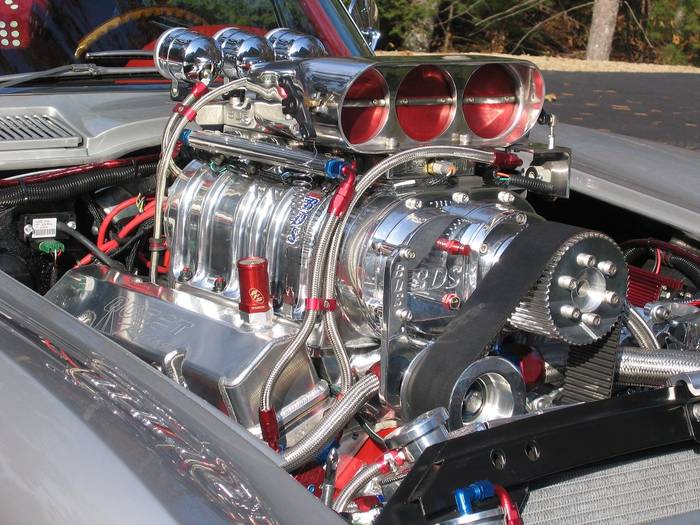
In a street situation, things get alot more complicated especially as the engine combination gets more radical. Consider this: suppose you are running a a typical "mid-range" CAM shaft with a power band from say 3000 - 6500 RPM. Most of the time that you drive on the street, you are operating below the 3000 RPM level. Lets also say that you are using a big carb (say 900 cfm on a 427 ci motor) to get the package to really haul from 4000-6000 RPM. When this combination idles or you drive it at part throttle below 2000 RPM, the overlap in the cam will cause serious intake reversion problems which will play hell with the carb's metering circuits. You'll probably have to jet/adjust the idle side so rich to compensate for this that you can hardly breath in your garage when the thing is warming up. How does EFI help? First off injectors (stacks or a throttle body) don't rely on a venturi effect to draw the fuel into the motor. This makes the EFI setup is much less prone to reversion problems and the associated need to get the car rich. Secondly, you have a much greater level of control over fuel (and timing) delivery than you can every get with a carb and no computer. I've had engines that will have a flat spot or hesitation at a certain throttle position and engine speed in both the TWM injected 482 ci FE and my 383 ci blown and injected SBC. In the FI case, I change maybe 4 specific cells in the fuel and timing tables to correct these probelms without effect the rest of the the tune at all. If I had to correct these problems with carbs I would have needed to make changes effecting a much larger area of the fuel and timing curves which would have created performance compromises elsewhere. Also, the large throttle blade area of the big carb choosed for high end performance along with the low vacumn of the cam make it very difficult for the carb to metter the fuel properly at low speed. The EFI system can much more accurate determine the amount of air acutally going into the motor and meter the fuel much more accurately. This is why you can get setups like the one shown below to run well on the street.
Lastly, the EFI controlled motor can make much better corrections for conditions than a carb can. Those with carbs ever notice that their cars perform much better at certain temperature/humidy conditions than others? Ever have you performance car run poorly when you took a drive to a higher altitude? Some of this is about air density and oxygen content but it is also about the carbs limited conditions to compensate for air temperature, humidy, and pressure. EFI systems have sensors that detect and will correct for all of these problems and many will used closed loop operation to deal with other issues and wear. Issues like these (as well as emmisions and fuel economy) are the reason that almost every production performance car made today uses EFI including cars like the Viper, GT500 mustangs, and Z06 vettes.
So why isn't everyone using EFI? Well for one thing, it costs more than a carb (althought the gap is getting more reasonable if you use quad throttle body systems). Its also more difficult to tune. All of the control and flexibility means that there are alot more "knobs" that you can turn. I would say that its not that much more difficult to put a near perfect tune on and EFI system than it is to do the same on a carb based motor (although the carb motor may still be subject to the comprimises listed above). The problem is that you can put a so-so tune on a carb much easier than on an EFI system. There is also the work to retrofit a vehicle that is not set up for EFI (especially an existing older car) to use EFI. Biggest areas of work here are 1) upgrading the fuel system to use a high pressure pump and a return line, 2) beefing up the electrical system to reliabily run the electronics, and 3) finding a spot to hide the computer and running the wiring. None of these things are particularly difficult but they do take some work.
I've built or messed with a lot of performance engines in my time (both race and street motors). The last two projects that I've done with EFI are probably two of the most radical that I've run on the street yet they are the two highest performance and most streetable engines I have worked with.
Net is that in practical terms for high performance motor used on the street, its hard to beat EFI. The biggest downsides are the cost, extra work to install, and the technical knowledge required to tune. If you bite the bullet and deal with these issues up front, you get rewarded with a car that usually performs much better/is more streetable and is therefore more fun to drive. BTRW, these days, the tuning part can be handled by many chassis dyno shops at pretty reasonable cost.
All of this said, a carb really is the best choice for many projects. This approach is certainly much simpler and usually more authentic for 60's-80's based muscle cars. The budget factor is also very important for most of us. I would have to say that one could almost always improve the OVERALL performance (not just peak HP/Torque at WOT) with an EFI system on the street over a carb though.
I hope this helps those of you having the EFI vs carb debate.
- Fred

|
02-17-2009, 02:21 PM
|
|
CC Member
|
|
|
Join Date: Nov 2006
Cobra Make, Engine: ERA, FE BBF
Posts: 389
|
|
Not Ranked
Quote:
Originally Posted by FUNFER2
Hey Fred, those look like good numbers for the hyd. cams.
I know quite a bit about motors and cams so, it's just deciding on the type. I like rollers and Keith said the one's he uses, with oil holes drilled in the bottoms, have lasted around 20,000 miles, which is a lot for our cobras.
We lash the valves on the sprint car every week but, having to lash the cobra all the time,....I don't know. I guess I'll ask you guys and Keith apx,...how often, if driven weekly.
I check my solid flat tappet twice per season. |
Hi Kevin,
It was nice talking with you today! For the benefit of others on the forum, let me share some of what we talked about on the issue of a hydraulic roller vs a solid roller cam. The big difference between a hydraulic roller vs a solid roller CAM setup has to do with valve train strength, weight, and therefore how agressive you can get with the lobe profile (ie how fast the CAM can open an close the valves). The lighter valve train weight of a solid roller (the lifters are lighter) also allows the engine using one to rev to higher RPMs. There are lots of good reasons to run a solid roller CAM in a race applications (sprint cars, drags, etc) where high RPM HP is very important. On the street where lower end torque is usually more important the advatages are less. Consider this. To get the lifter to stay on a very radical lobe that most solid roller CAMs use to gain their performance advantage, you need to use VERY stiff springs and make all of the other valvetrain components as light as possible. Its not uncommon to see springs that increase seat pressure substainly and the use of exotic components like titanium valves and retainers in such engines for example. All of this works great in a race motor but you would have a hard time making such a setup last on the street. What did the CAM manufactures do to address the street guys who want to say they've running a "solid roller" cam? They created a less radical set of lobe profiles that don't require all of the exotic valvetrain components. These CAMs do produce some more lift and may rev a little higher than the hydraulic roller alternatives but the gains are much less pronounced than a race solid roller setup. In a street appplication that is operated below 3000 RPM and maybe buzzed to 5500 RPM once in awhile, I'm not sure that the performance gains would be great enough to justify the added expense and maintenance. I would build the motor with an aluminum flywheel instead and spend the difference somewhere else. This will get you a good bit of the fast reving performance that you are looking for and should be OK in a lightweight car like a cobra. Hope this helps.
- Fred
|
02-17-2009, 06:15 PM
|
|
CC Member
|
|
|
Join Date: May 2006
Location: St. Louisville,
Oh
Cobra Make, Engine: A&C 67 427 cobra SB
Posts: 2,446
|
|
Not Ranked
Quote:
Originally Posted by mr. oz
From Pro Systems website:
Carburetors and Electronic Fuel injection are two completely different systems. They share no concepts and each has a different theory.
EFI's claim is this: I will supply sprayed droplets of fuel at the proper air to fuel ratio all the time.
Carburetors claim: I will supply a pre-emulsed froth of fuel and air into the engine at a preset ratio.
|
Interesting mr. oz.
A 20 degree drop on an 80 deg day would increase the air density about 4%. That would be aroung 16 hp on a 450 hp engine.
If the fuel does go through a phase change from liquid to a gas it would cool the air. The phase change would have to happen in the plenum to be a benefit. It sounded like not just any carb would do this well.
Since gasoline at atmouspheric pressure needs to be up near 500F to phase change to a gass, it does not want to do this. I really do not understand the physics behind emulsed froth. I don't understand why the fine spray of an injector is totally different from this. Maybe someone can enlighten me. I'm always willing to learn.
|
02-18-2009, 06:34 AM
|
 |
CC Member
|
|
|
Join Date: Feb 2001
Location: St. Louis, Missouri,
MO
Cobra Make, Engine: SPO 2715
Posts: 1,648
|
|
Not Ranked
 new thread?
Is there existing, or start a new "EFI compared to Carb" thread?
I have more to post but this is taking away from the OP's original topic, IMO.
E
|
02-18-2009, 06:41 AM
|
|
CC Member
|
|
|
Join Date: Oct 2002
Location: Eagle,
Ne.
Cobra Make, Engine: 1966 Lone Star 427SC.
Posts: 4,310
|
|
Not Ranked
It don't matter to me E, it's all very interesting. 
__________________
Regards,
Kevin
|
 Posting Rules
|
You may not post new threads
You may not post replies
You may not post attachments
You may not edit your posts
HTML code is Off
|
|
|
All times are GMT -7. The time now is 09:27 AM.
|















 Linear Mode


