 
 Main Menu
|
|
Nevada Classics
|
|
Advertise at CC
|
| S |
M |
T |
W |
T |
F |
S |
| |
|
|
|
|
1 |
2 |
| 3 |
4 |
5 |
6 |
7 |
8 |
9 |
| 10 |
11 |
12 |
13 |
14 |
15 |
16 |
| 17 |
18 |
19 |
20 |
21 |
22 |
23 |
| 24 |
25 |
26 |
27 |
28 |
29 |
30 |
| 31 |
|
|
|
|
|
|
|
|
CC Advertisers
|
|
 35Likes 35Likes

02-09-2021, 12:40 AM
|
 |
CC Member

|
|
|
Join Date: Sep 2003
Location: Switzerland,
CH
Cobra Make, Engine:
Posts: 538
|
|

 Not Ranked
Quote:
Originally Posted by Dan Case

It was replaced by a similar kit in mid 1967 under number SFJK-9510-E with a “SHELBY” lettered intake.
|
MANY THANKS for the provided information as I use one with my 48IDA Weber'. 

__________________
Driving with your Cobra is fun,
Racing with your Cobra is amazing,
Driving hill-climbing races with your Cobra is.... HAVEN!!
|
02-09-2021, 08:14 AM
|
 |
CC Member
|
|
|
Join Date: Apr 2004
Posts: 1,033
|
|
Not Ranked

Quote:
Originally Posted by ALF
MANY THANKS for the provided information as I use one with my 48IDA Weber'. |
You are welcome. Back in the 1980s I got the idea to obtain one of every aluminum 4V intake used or sold by Shelby American for 260/289 c.i.d. engines. I started buying an intake here and there. Then I got the idea how many different versions there were. At one point in time my wish list had something like seventeen (17) versions covering three (3) casting companies two (2) shops doing the machining plus intakes were sent out to be race prepared by at least two (2) different contractors. Whew ! Since then I have learned of more 1965 and 1967 made versions. In 1965 Shelby American also offered a semi-finished piece that racers could machine any way they wanted. I dropped that collection idea.
Then I said what about intakes for Weber carburetors. That list grew quickly and that idea was also scrapped.
If either ‘intake collection’ had ever come about I would have needed a lot of wall space. The cost of such collections would also been significant to our budget even spread over many years. I settled for something smaller.
All of these are original mascots and identifiers. Some are new old stock. I am only missing one piece to have a type set. It is unlikely that I will ever get a S1CS-B Version 1 mascot. I have never seen one except in day one pictures or on an unrestored early Cobra. I started collecting for this set in the summer of 1972.

__________________
Dan Case
1964 Cobra owner since 1983, Cobra crazy since I saw my first one in the mid 1960s in Huntsville, AL.
Last edited by Dan Case; 09-19-2021 at 10:15 AM..
Reason: grammer
|
02-09-2021, 08:37 AM
|
 |
CC Member
|
|
|
Join Date: Aug 2013
Location: Canandaigua,
NY
Cobra Make, Engine: SPF MKII Riverside Racer FIA
Posts: 2,504
|
|
Not Ranked
Dan,
Those look like DCOE's to me. Same orientation, body and air horns.

Do you know if they made any modifications to the cold air intake to redirect the air for a side draft carb? On my MGB I fabricated a cold air box that would take air from the side of the radiator and block any air coming through the radiator from the air horns. A hood scoop would not feed side draft carbs very well.
Jim
__________________

|
02-07-2021, 05:11 PM
|
|
CC Member
|
|
|
Join Date: Feb 2013
Cobra Make, Engine:
Posts: 18
|
|
Not Ranked
Interesting. Thanks for the reply. This is certainly not something that was made recently and is a very heavy casting for what it is. Maybe some sort of prototype?
Jason
|
02-07-2021, 05:19 PM
|
|
CC Member
|
|
|
Join Date: Apr 2004
Posts: 1,033
|
|
Not Ranked
Quote:
Originally Posted by SuperNovaSS
Interesting. Thanks for the reply. This is certainly not something that was made recently and is a very heavy casting for what it is. Maybe some sort of prototype?
Jason
|
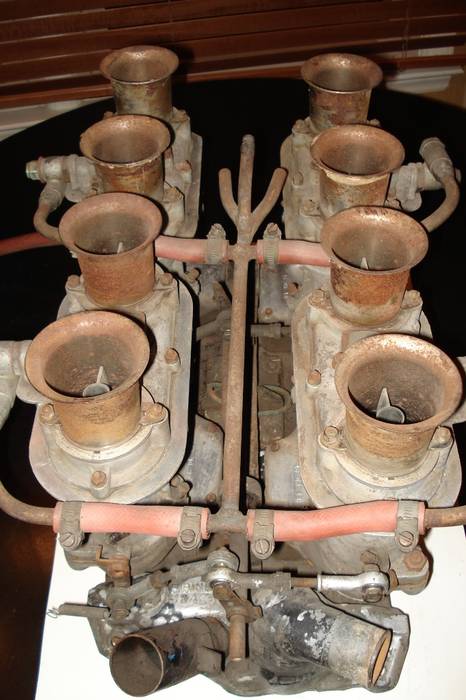
You are welcome. I have seen quite a few custom Ford 260/289/non-Boss 302 engine "Weber" intakes side draft and down draft over the years. There are some really strange ones out there. How about 48 mm size carburetors down the middle in a line like an Italian car for Ford 260 engines. (Ford's 255 INDY engine used four 58 DSF models down the middle...got that 4 each 58 mm carburetors on a 255 c.i.d. engine.) BUT not as strange as some of the Moon-McKay "Weber" intakes for SBC engines! I am told that the Winters company (think Chevy aluminum intakes) made the 4-2V intakes for the 45 IDM carburetors for the Chevy powered Maserati racers in the 1950s. I have no idea if that is true. The family that owned one of the Maserati racers Mr. Shelby drove tried to sell me the complete 45 IDM carburetor based induction system from the car.
__________________
Dan Case
1964 Cobra owner since 1983, Cobra crazy since I saw my first one in the mid 1960s in Huntsville, AL.
Last edited by Dan Case; 02-08-2021 at 07:16 AM..
Reason: add picture
|
02-07-2021, 05:32 PM
|
|
CC Member
|
|
|
Join Date: Apr 2004
Posts: 1,033
|
|
Not Ranked
COUGAR intake
If any readers have a COUGAR lettered Lincoln-Mercury 289/non-Boss 302 intake that has not been polished I sure would like to get some pictures for my archive.
I have come across two COUGAR intakes but unfortunately for my archive purposes both had been highly polished all over.
Thanks.
Dan
__________________
Dan Case
1964 Cobra owner since 1983, Cobra crazy since I saw my first one in the mid 1960s in Huntsville, AL.
|
02-07-2021, 05:47 PM
|
|
CC Member
|
|
|
Join Date: Feb 2013
Cobra Make, Engine:
Posts: 18
|
|
Not Ranked
Thanks again for the detailed replies Dan.
Jason
|
02-08-2021, 07:07 AM
|
|
CC Member
|
|
|
Join Date: Nov 2003
Location: New Britain,
CT
Cobra Make, Engine: Size 10 Feet
Posts: 3,031
|
|
Not Ranked
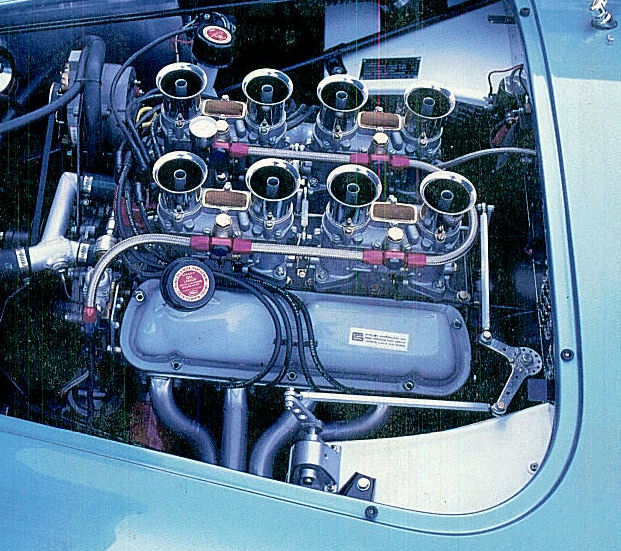
The original FIA's intake had two water outlets pointing forward. There was a cast connector with an outlet on the left side, pointing toward the radiator. No thermostat, but probably a restrictor somewhere. I've seen some pictures showing an additional bracket on the connector that held a fuel distributor (1 in, 4 out). Our "Number 142" had a fabricated part rather than a cast one, but the layout is similar.
 |
02-08-2021, 07:16 AM
|
|
CC Member
|
|
|
Join Date: Aug 2013
Location: Canandaigua,
NY
Cobra Make, Engine: SPF MKII Riverside Racer FIA
Posts: 2,504
|
|
Not Ranked
This is from mine that shows an example of the fuel distributor mentioned in the prior posting from my SPF.  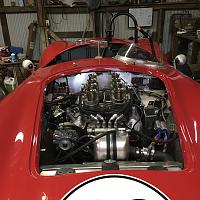
Unfortunately Dan, I do not have a picture of a COUGAR lettered intake for you.
Jim
__________________
|
02-08-2021, 08:20 AM
|
|
CC Member
|
|
|
Join Date: Apr 2004
Posts: 1,033
|
|
Not Ranked
Quote:
Originally Posted by 1795
This is from mine that shows an example of the fuel distributor mentioned in the prior posting from my SPF.
Unfortunately Dan, I do not have a picture of a COUGAR lettered intake for you.
Jim |
An original unrestored 1963-64 water neck and fuel log assembly made in the Shelby American race shop. We are using this piece in our red car. This was not the only version.
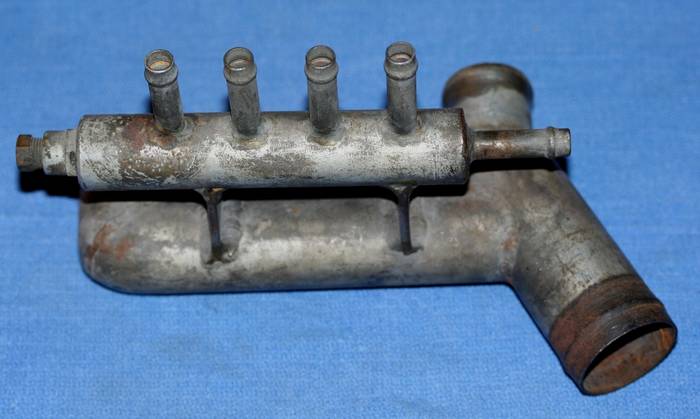
I did not want to run without a thermostat (wanted flow control and temperature regulation). A version of Ford tractor thermostat can be modified to slip inside the upper radiator hose in a few minutes. I also added a polar array of tiny holes around the mechanism to allow air to pass when refilling the cooling system and coolant to pass low flow all around the thermostat during engine warm up.
__________________
Dan Case
1964 Cobra owner since 1983, Cobra crazy since I saw my first one in the mid 1960s in Huntsville, AL.
Last edited by Dan Case; 02-08-2021 at 08:30 AM..
Reason: spelling
|
02-08-2021, 08:45 AM
|
|
CC Member
|
|
|
Join Date: Aug 2013
Location: Canandaigua,
NY
Cobra Make, Engine: SPF MKII Riverside Racer FIA
Posts: 2,504
|
|
Not Ranked
Dan,
On mine we added an inline adapter between the water outlet and the radiator that could house a thermostat. Being that it is a race car we used a restrictor plate so that the water would be able to flow (and air be released as well during a fluid change), but at a reduced level to ensure that the engine is running at optimum temps.
I have used the drill small holes in the thermostat method as well to aid in releasing of trapped air bubbles.
Jim
__________________
|
02-08-2021, 09:08 AM
|
|
CC Member
|
|
|
Join Date: Apr 2004
Posts: 1,033
|
|
Not Ranked
Quote:
Originally Posted by 1795
Dan,
On mine we added an inline adapter between the water outlet and the radiator that could house a thermostat. Being that it is a race car we used a restrictor plate so that the water would be able to flow (and air be released as well during a fluid change), but at a reduced level to ensure that the engine is running at optimum temps.
I have used the drill small holes in the thermostat method as well to aid in releasing of trapped air bubbles.
Jim
|
Shelby American's air bleed method was manual. Cars through CSX2200 used one of these "upper bleeder" tube assemblies near the radiator inlet with a Smiths® mechanical temperature sensor and a pipe plug. Any Cobra with factory installed 4-2V induction got one of these (early) or one set up for some other sensor. Street car parts through CSX2200 were normally just painted with black enamel. Later race car parts were often cadmium plated. I had the ones I made for restorations cadmium plated.
This is one of the Shelby American production drawings views.

I believe John Bessey makes nice recreations of these also.
CSX2201 and later street cars did not get "upper bleeder" tubes. Getting the air out after a total coolant refill can be a challenge.
__________________
Dan Case
1964 Cobra owner since 1983, Cobra crazy since I saw my first one in the mid 1960s in Huntsville, AL.
Last edited by Dan Case; 09-19-2021 at 10:12 AM..
Reason: add detail
|
02-08-2021, 08:11 AM
|
|
CC Member
|
|
|
Join Date: Apr 2004
Posts: 1,033
|
|
Not Ranked
Quote:
Originally Posted by strictlypersonl
The original FIA's intake had two water outlets pointing forward. There was a cast connector with an outlet on the left side, pointing toward the radiator. No thermostat, but probably a restrictor somewhere. I've seen some pictures showing an additional bracket on the connector that held a fuel distributor (1 in, 4 out). Our "Number 142" had a fabricated part rather than a cast one, but the layout is similar.
|
All the known period "factory" intakes (COBRA/FAV/FORD SK prototypes/FoMoCo/SHELBY/COUGAR) that I have pictures of had two coolant connections for hoses. 1962-1967 there all kinds of water necks, fuel logs, and water necks with integral fuel logs. Some were one offs. One general design combining water neck and fuel log were used on most team Cobras, most factory supported Cobras, and most retail sale Stage III and Stage IV engines. John Bessey provides an excellent recreation of the most common design. Shelby American used steel fabrications they made themselves as desired and as required. Circa 1966 they offered retail a cast aluminum COBRA lettered water neck; ‘hollow letter’ like COBRA text on 1963-early 1966 cast aluminum rocker arm covers and oil pans. Circa 1967 the “COBRA” letters became ‘solid letter’ like the late 1966 onward die cast GT350 rocker arm covers.
The companies completing and racing Cobras 1962-64 were mostly rather small ones. Small groups driven to win not burdened with an enormous staff in many layers could and did make changes rapidly. Some of the Shelby team cars changed in some way just about every race. That leads me to intakes and water necks / fuel logs from the Cobra world ignoring what FoMoCo HQ was doing in Michigan and Ford Advanced Vehicles was doing in the UK. There was not just one of anything design wise. One could fill a nice little size book just covering the known versions of COBRA intakes:
Standard weight
Reduced weight
Original as cast ports at head flanges
Revised larger as cast ports at head flanges
Customer intakes normally as cast
SA team intakes normally fully prepared ports matched to racing cylinder heads
Opposed carburetor layout
Parallel carburetor layout
Intakes for unmilled heads
Intakes for milled heads
That’s the general outline for intakes. Fuel logs and water necks would be a really complicated. The bigger the scope the bigger the coverage gets real fast.
If I start with the definition that a “system” was everything (bearings, jam nut, carburetors, hose clamps, whatever) Shelby American tested, used, or sold 1962-67 then I have documented details of thirteen (13) different types of “COBRA” systems Shelby American tested at least once, used, and or sold. Within in a type team cars usually were often done slightly differently and that made subset versions.
10 each versions of ready to install intakes at least (that I know about), includes two layouts
4 each 48 mm carburetor models (IDM1, IDM5, IDA, IDA1)
3 each versions of carburetor inlet (2 with internal screen filters and 1 just a banjo fitting)
4 each linkage systems (not counting getting from foot box to intake)
9 each water necks and or fuel log combinations (that I know about)
2 each brands of hose band clamps
2 each types of band clamp screws (hex and safety)
3 each lengths of Dorman® mounting studs
3 each versions of Mil-Spec hex nuts for mounting studs
5 each version of center bellcrank assembly (that I know of)
Parts fabricated by Shelby American as required (several) and desired.
Parts purchased from somebody else.
Most of the “original” systems you will see are conglomerations of whatever somebody found or desired. I know of just a handful of factory installations that never got broken up into pieces. When we worked on Steven Juliano’s CSX2416 we were fortunate that a magazine company took a collection of engine bay pictures of the car after it was completed but before it was delivered to the dealer. The detail in the photos was fantastic down to individual hose clamp details. It took Steven and I years to come up will all the correct parts to make the restored car match the day one picture set induction system wise. I got lucky early with a set of two digit serial number carburetors that found me. It was fortunate that I have an unrestored identical original works race shop system on our red car to get down to very tiny details.
__________________
Dan Case
1964 Cobra owner since 1983, Cobra crazy since I saw my first one in the mid 1960s in Huntsville, AL.
Last edited by Dan Case; 09-18-2021 at 07:04 AM..
Reason: add detail
|
02-08-2021, 10:03 AM
|
|
CC Member
|
|
|
Join Date: Mar 2009
Location: Mendota,
IL
Cobra Make, Engine:
Posts: 697
|
|
Not Ranked
Dan Thank You for posting the things you post!
Mark
|
02-08-2021, 12:14 PM
|
|
CC Member
|
|
|
Join Date: Apr 2004
Posts: 1,033
|
|
Not Ranked
Quote:
Originally Posted by MAStuart
Dan Thank You for posting the things you post!
Mark
|
You are welcome.
__________________
Dan Case
1964 Cobra owner since 1983, Cobra crazy since I saw my first one in the mid 1960s in Huntsville, AL.
|
02-10-2021, 03:39 AM
|
 |
CC Member/Contributor
|

|
|
Join Date: Sep 2016
Location: (Beautiful) Sequim,
WA
Cobra Make, Engine: Pacific Roadster, 347 cu.in. 5-speed
Posts: 2,018
|
|
Not Ranked
Glen, that motor XHP-260-2 still resides in Pete Lovely's "Zoomer". Pete bought the motor from Carroll back in 1965-67? to install in the Zoomer, since it was basically a 1/3 scale larger Louts Super 7, I wonder if those DCOE's and manifold were for that car? I can contact long time owner after Pete (And long time friend of Pete) to see if he has any info. of that set-up. Interesting  Cheers TommyRot.
Last edited by Alfa02; 02-10-2021 at 03:42 AM..
|
02-10-2021, 09:20 AM
|
|
CC Member
|
|
|
Join Date: Apr 2004
Posts: 1,033
|
|
Not Ranked
Some Weber Down Draft Carburetors
Over the last two decades plus I have collected information that I could find on down draft E. Weber carburetors between the 1950s to late 1960s. There were a lot designs and suffixes. I bought some factory manuals on theory, design, and practice. I did not make notes on every design version but I did collect a little information that more or less looks like evolution outline that culminated in the 48 IDA and 48 IDA1 two choke carburetors that became so famous.
I cannot guarantee that my lineup is correct chronologically between the 35 IDM 2C and 46 IDM 2C families. It is very likely that multiple versions were somewhere in the design to distribution phases simultaneously. So what little this is worth:
35 IDM two choke, sand castings, down draft – Maserati 250F and 350S engines.
38 IDM two choke, sand castings, down draft – Maserati “Birdcage” race cars. Mr. Shelby raced one of these cars.
40 IDF (not IDM) two choke, sand castings, down draft – for small displacement Italian engines.
45 IDM two choke, sand castings, down draft – used in the Maserati 450S (and perhaps other cars) circa 1956-58. (Carroll Shelby raced, as driver, one of these cars.)
45 IDM? two choke, sand castings, down draft – used on the Maserati 5000 GT street car for 1959 model year.
46 IDM two choke (new design, significantly different in many ways than the previous 45 IDM two choke model), sand castings, down draft. Two assemblies were used in Porsches that I have found reference for: 46 IDM1 (Porsche 1500 RSK) and 46 IDM2 (Porsche CARRERA) assemblies.
48 IDM two choke, sand castings, down draft - developed (originally created by reworking existing 46 IDM assemblies) for a Maserati F1 effort with very few sets made - circa 1960-62 .
58 DSF two choke, sand cast. Ford Motor Company developed an aluminum 255 c.i.d. push rod operated over head valve “INDY” engine during 1962 and into 1963 with four (4) each 58 DSF E. Weber two choke down draft carburetors mounted in a row down the middle of the valley between cylinder heads.
48 IDM1 or 48 IDM5 two choke, sand castings (Note: IDM1 and IDM5 assemblies are based on different main body castings), down draft - appears on anything Ford Motor Company / Carroll Shelby Enterprises / Shelby American, Inc. had anything to do with in V8 engines using down draft systems. Used until circa late March / early April 1964 for Shelby team cars. I have not seen any pictures but for there to be 48 IDM1 and IDM5 assemblies I have to wonder what suffix 2, 3, and 4 assemblies were? The 48 IDM family of carburetors found use in multiple brands of American V8 powered sports and sports racing cars before the die cast IDA 2C family came out. Some racers kept using them at least for a while after 48 IDA/IDA1s came out. A 1965 MUSTANG GT350 was raced in Canada with some version of 48 IDM carburetor before being converted to IDAs.
40 IDA 3C - (three choke, i.e. three venturi or 3V in America), die castings, developed for Porsche (now three 40 mm throttle bores instead of two 46 mm ones).
48 IDA 2C (two choke), die castings – The production ready Weber engineering drawings for the 48 IDA model were dated September 7, 1963. 48 IDA family models were considerably lighter weight than the 48 IDM family models and were assembled with 42 mm chokes. The first production units did not appear at Shelby American until very late in March 1964 or very early April 1964 the best I have been able to determine. Vague E. Weber published texts could make one believe the 48 IDA model was created and initially developed for what would become known as the Ford GT40 MKIs.
48 IDA1 - appears at Shelby American in the same time frame as the 48 IDA. 48 IDA1 models were manufactured with 42 mm chokes. The difference between models was in throttle arms supplied and that did not matter to Shelby American (or Ford Advanced Vehicle in the GT40) as they replaced them with custom new Shelby American (or Ford Advanced Vehicle) designs anyway.
46 IDA2 and 3, two choke - Edorado Weber manuals indicate they were for a Porsche application. The only 46 mm versions that I have come across in an American "factory" context were in a four carburetor small displacement aluminum V8 engine system that came out of a GM engine development operation. A single carburetor has been found in use in a hot rod. Visually they look just like 48 mm models.
48 IDA4 for Dean Moon. 48 IDA4 models were manufactured with 37 mm chokes. Dean Moon's Moon and McKay companies sold no telling how many systems for Chevrolet or other GM engine powered applications. (Personal correspondence from Dean Moon to a potential customer post marked June 28, 1966, includes an undated “WEBER THE KING OF CARBURETION” news letter advertising 48IDA1 carburetors for custom induction systems for a variety of American V8 applications, includes an undated copy of a typed spare parts list for “48 IDA – IDA 1 - - 46 IDA 2 – 46 IDA 3 48 IDA 4”. This is the earliest documentation that I have found to date on the “48 IDA 4” model. Mr. Moon indicated that IDA4s were for applications where IDA1s were too large. The next reference found was in a 1967 catalog. February 1967, GEON, WOODBURY NEW YORK, "48IDA4 COBRA (SHELBY)", no pricing available, under price is “P.O.A.”, printed in U.S.A. This is the earliest published catalog mention and only printed information during the 1960s related to the “48 IDA4” that I have located to date. This is a Geon publication and not one from Weber, Moon, Ford, or Shelby.) (Did you notice? Geon advertised assemblies with 37 mm chokes as replacements for models with 42 mm chokes in reference to “COBRA (SHELBY)”.) The 48 IDA4s were very popular in marine applications for a long time.
__________________
Dan Case
1964 Cobra owner since 1983, Cobra crazy since I saw my first one in the mid 1960s in Huntsville, AL.
Last edited by Dan Case; 08-27-2021 at 10:38 AM..
Reason: add detail
|
02-10-2021, 09:45 AM
|
|
CC Member
|
|
|
Join Date: Apr 2004
Posts: 1,033
|
|
Not Ranked
Quote:
Originally Posted by Alfa02
Glen, that motor XHP-260-2 still resides in Pete Lovely's "Zoomer". Pete bought the motor from Carroll back in 1965-67? to install in the Zoomer, since it was basically a 1/3 scale larger Louts Super 7, I wonder if those DCOE's and manifold were for that car? I can contact long time owner after Pete (And long time friend of Pete) to see if he has any info. of that set-up. Interesting Cheers TommyRot. |
Interesting.
I almost bought the Zoomer twice, damned near said yes both times before I realized we didn't "need" any more old cars. When I became aware of the car the first time it was not for sale and it showed less miles than 400 miles showing on the odometer. The current induction system at the time was a High Performance 260 only cast iron intake and a High Performance 390 Police Interceptor Ford 4100 4V carburetor. (Experimental High Performance 260 cast iron intakes were different. The current ignition distributor at the time was a High Performance 260 dual unit and not one of the Experimental High Performance 260 dual point units. I have the engineering information and assembly dates for both assemblies I recorded quite a few years ago.)
https://www.fantasyjunction.com/sold...oomer/overview
__________________
Dan Case
1964 Cobra owner since 1983, Cobra crazy since I saw my first one in the mid 1960s in Huntsville, AL.
|
02-10-2021, 01:28 PM
|
 |
CC Member
|
|
|
Join Date: Feb 2013
Location: Carlsbad,
Ca
Cobra Make, Engine: SAI FIA, 289HP (5-bolt), 48IDA Webers
Posts: 1,244
|
|
Not Ranked
The 46 IDA was a replacement carburetor for the Porsche Four Cam engines that were originally factory equipped with 46 IDM carburetors. There is no factory literature that calls out a 46 IDA carburetor only the IDM carburetors.
|
02-10-2021, 03:21 PM
|
|
CC Member
|
|
|
Join Date: Apr 2004
Posts: 1,033
|
|
Not Ranked
Quote:
Originally Posted by CompClassics
The 46 IDA was a replacement carburetor for the Porsche Four Cam engines that were originally factory equipped with 46 IDM carburetors. There is no factory literature that calls out a 46 IDA carburetor only the IDM carburetors.
|
Thanks.
__________________
Dan Case
1964 Cobra owner since 1983, Cobra crazy since I saw my first one in the mid 1960s in Huntsville, AL.
|
| Thread Tools |
|
|
| Display Modes |
Rate This Thread |
 Hybrid Mode Hybrid Mode
|
|
 Posting Rules
|
You may not post new threads
You may not post replies
You may not post attachments
You may not edit your posts
HTML code is Off
|
|
|
All times are GMT -7. The time now is 08:49 AM.
Links monetized by VigLink
|